
Broccoli Companion Plants: What to Grow Nearby
The broccoli companion plants worth growing are the ones that draw pests away from the crop or crowd it the least, and the list is shorter and less certain than most garden charts make it look. Broccoli is a cool-season brassica grown as an annual in USDA zones 5 to 9, and it gets hit by aphids, cabbage worms, cabbage loopers, and flea beetles. What you plant beside it can help a little, but it can also make problems worse.
One claim needs correcting up front. Companion plants do not reliably repel every broccoli pest, and they do not reliably raise yields. Extension guidance supports trap crops and strongly scented plants as one possible pest-management tool, but it does not promise protection or establish universal broccoli pairings. Treat companions as a bonus on top of good spacing and regular checking, not a replacement for either.
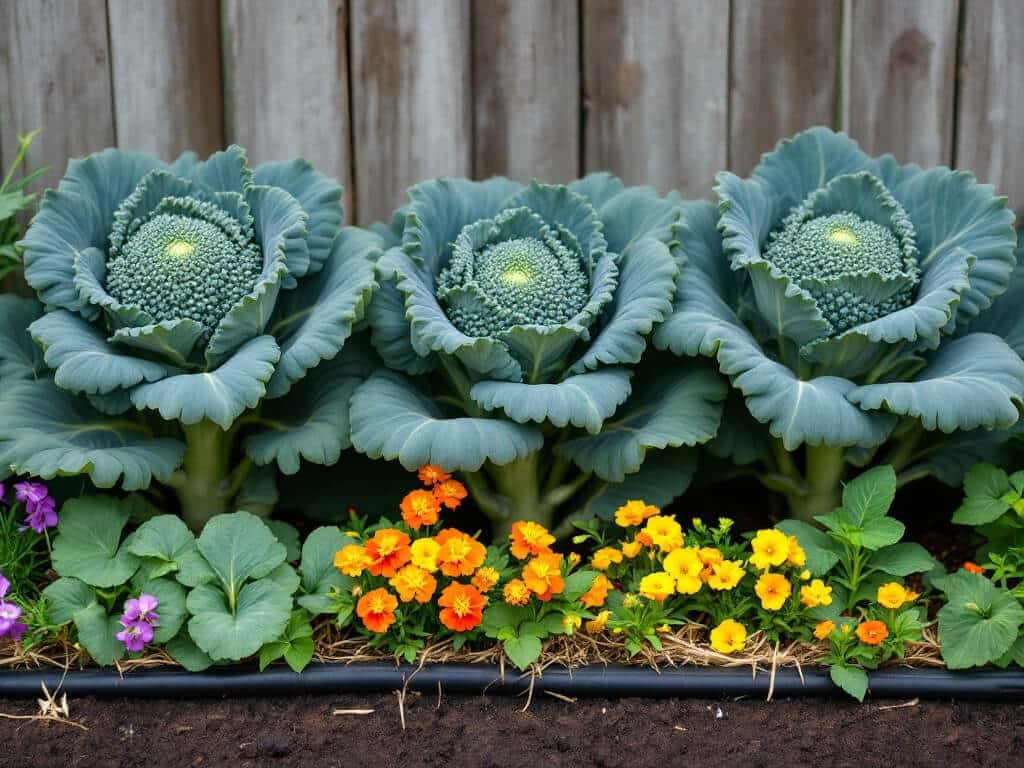
Why pairings matter for broccoli
Broccoli wants full sun (light shade is tolerated), fertile and well-drained soil that still holds moisture, and steady watering. Anything you plant next to it either fits those needs or competes with them. A neighbor that shades the heads, crowds the leaves, or soaks up water works against the crop, whatever its reputation as a companion.
The second reason is disease. Broccoli is prone to damping-off as seedlings and to Alternaria leaf spot and head rot later on. Dense planting holds moisture on the foliage, which raises disease risk. Overhead watering does the same, so water at the base when disease is a concern.
The third reason is pest pressure. Broccoli’s main pests also feed on its relatives, so planting more brassicas nearby can concentrate them. A good pairing pulls pests toward a sacrificial plant or adds a strong scent to the bed. A bad one gives the same pests more to eat in the same spot.
Best companion plants for broccoli
Be realistic about what follows. None of these sources gave a broccoli-specific spacing figure for any companion, so I won’t invent one. Use each companion’s own variety label for spacing, and keep broccoli’s spacing intact.
Nasturtium
Nasturtium can work as a trap crop, pulling aphids and flea beetles away from brassicas. Plant it at the edge of the bed rather than in the broccoli’s root zone. Spacing depends on the nasturtium cultivar, so check the seed packet for its mature spread.
Radish
Radish may act as a trap crop for flea beetles, root maggots, and cabbage maggots, drawing them away from the brassicas you care about. Sow it in a separate nearby row so the two crops don’t crowd each other. It comes with a catch, covered in the next section, because radish is a brassica too.
Onion
Utah State Extension lists strongly scented plants like onions among those known to repel common garden pests. Place them near the broccoli, not tight against it. Space them according to the onion variety, and make sure they don’t cut into the airflow around the broccoli plants.
Garlic
Garlic is grouped with onions and chives as a strongly scented pest-repelling plant. Grow it in a nearby row or along the bed edge. Don’t tighten broccoli’s spacing to make room for it.
Chives
Chives are another strongly scented plant that may repel common garden pests. Keep the clumps outside the broccoli’s main growing space, since they spread and you don’t want them competing at the roots. Follow the spacing for the chive variety you buy.
Marigold
Utah State Extension names marigolds among the pest-repellent plants that can be paired with vulnerable crops, broccoli included. Use the variety’s mature spread to decide where it goes, because marigolds range in size. The source does not confirm reliable control of any one pest, so think of marigolds as a possible help and not a defense.
Other non-brassica herbs and flowers
Other herbs and flowers outside the brassica family can add habitat for beneficial insects. The available extension sources did not verify a broccoli-specific benefit or a spacing figure for these, so I’d treat them as optional. If you add them, keep them at the bed edge and don’t assume any fixed distance is correct.
What not to plant with broccoli
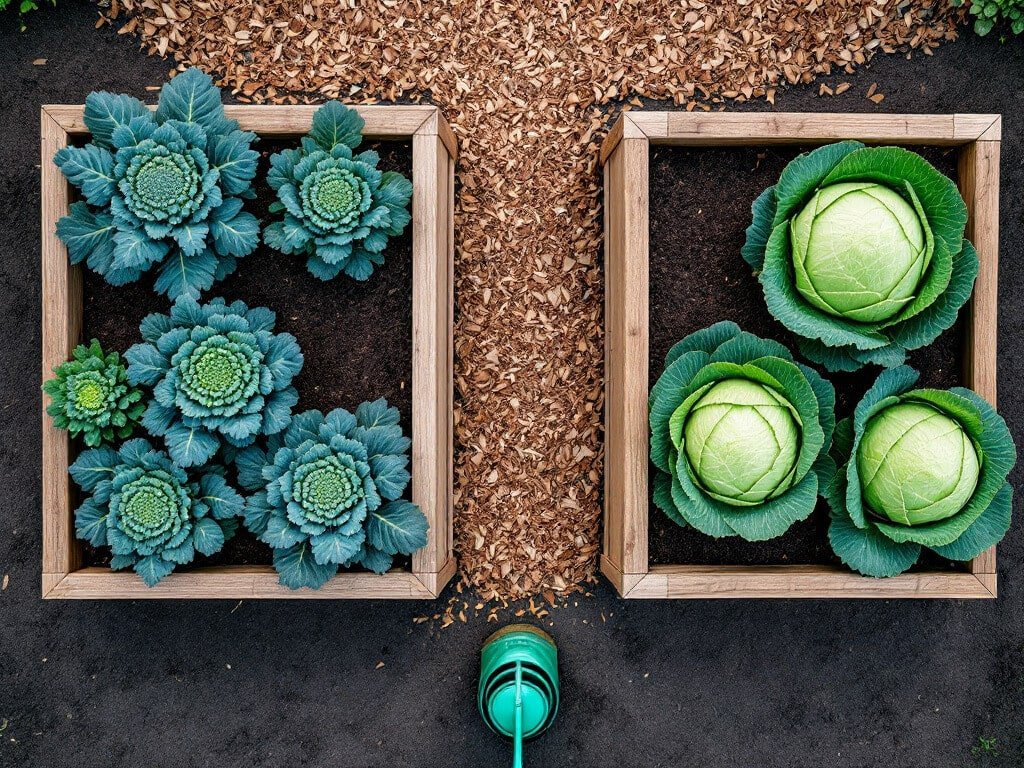
The list of bad companions is mostly about family ties and crowding, not a catalog of enemies.
Cabbage, cauliflower, kale, collards, mustard greens, bok choy, and Brussels sprouts
These all belong to the brassica family and share many of broccoli’s pests and diseases. Growing them together can concentrate problems in one bed. Crop rotation guidance also says to avoid planting brassicas repeatedly in the same spot. No single interplanting distance was verified, so the safer approach is to keep them in separate beds and rotate.
Radish in beds with brassica disease
Radish can serve as a trap crop, but it is also a brassica. Where brassica diseases like Alternaria keep coming back, skip it. The trap-crop benefit isn’t worth feeding the disease cycle in that bed.
Tillage radish and other brassica cover crops
Don’t use these as cover crops where Alternaria or a related brassica disease has been a problem. They can keep brassica disease risk going in the soil from one season to the next. If you’ve had Alternaria leaf spot or head rot, choose a non-brassica cover instead.
Anything that crowds the broccoli
The sources don’t give a fixed list of species that never work with broccoli. What they do say is that dense planting raises moisture and disease risk, so any plant that blocks airflow or crowds the broccoli is a poor neighbor. That includes good companions planted too close. Don’t shrink broccoli’s spacing to fit a companion in.
Layout and spacing
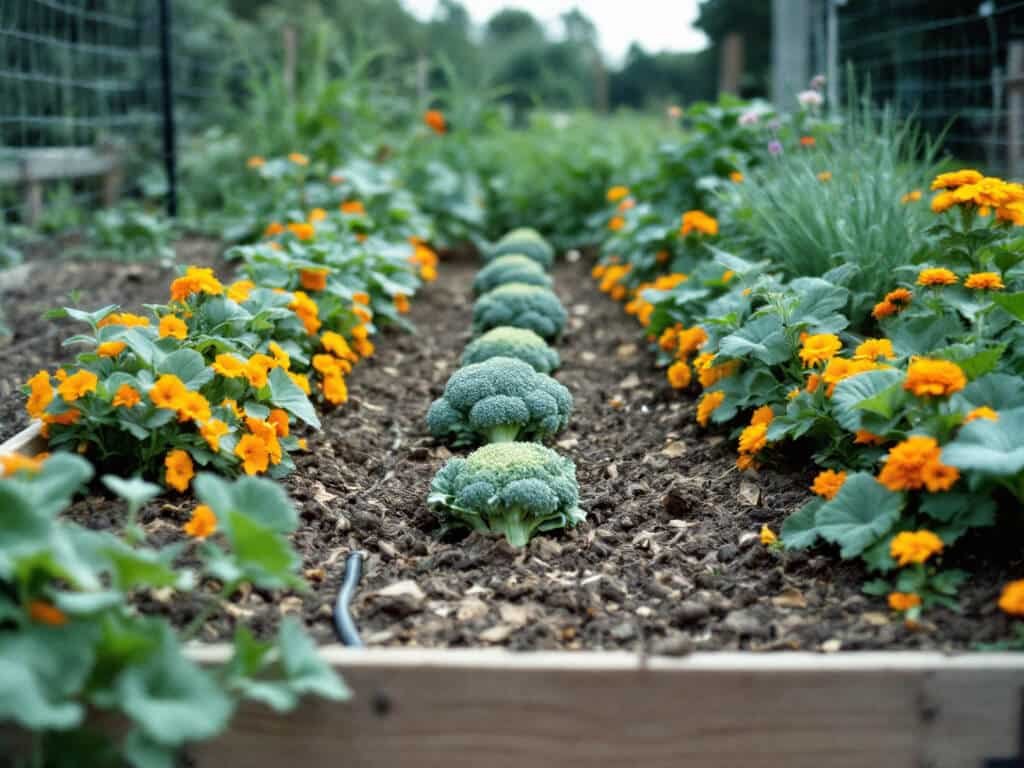
Give broccoli a sunny, well-drained bed and its full spacing first, then fit companions around the edges. Plan for roughly 10 to 18 inches between plants and 18 to 36 inches between rows, adjusted to your cultivar or the label on the seed packet.
– Run the broccoli in the center of the bed at full spacing.
– Put nasturtium along the bed edge as a trap crop, outside the broccoli’s root zone.
– Sow radish in a separate nearby row, but only if the bed has no history of brassica disease.
– Place onions, garlic, chives, or marigolds at the edges or in nearby rows, where they won’t reduce airflow or compete with developing heads.
– Keep other brassicas in a different bed and rotate where broccoli grows each year.
– Water at the base of the plants and keep moisture consistent.
FAQ
Can broccoli and tomatoes be planted together?
The available sources don’t establish a specific broccoli and tomato incompatibility. Broccoli still needs fertile, well-drained soil, consistent moisture, and good airflow, so use the spacing for both crops and don’t assume the pairing helps either one.
Do marigolds protect broccoli from cabbage worms?
Utah State Extension lists marigolds among pest-repellent plants that may be paired with broccoli, but the source doesn’t verify reliable control of cabbage worms. Keep checking the broccoli directly and use an integrated pest-management approach.
Should radishes be planted beside broccoli?
Radishes may trap flea beetles, root maggots, and cabbage maggots, but they are brassicas and share disease risks with broccoli. Skip them in any bed with recurring brassica disease, especially Alternaria.