
Baptisia Companion Plants for a Low-Care Border
Choosing baptisia companion plants comes down to one thing: match the site, then leave room. Baptisia wants full sun and well-drained soil, and once established it gets by on average to dry conditions. Anything you plant beside it should be fine with that, and shouldn’t crowd a plant that ends up 2–4 feet tall and about as wide.
This list sticks to plants that share those conditions, plus a short list to keep away from it. Where the research gives no exact spacing, I say so and point you to the plant’s own mature width instead of making up a number.
Why pairings matter for baptisia
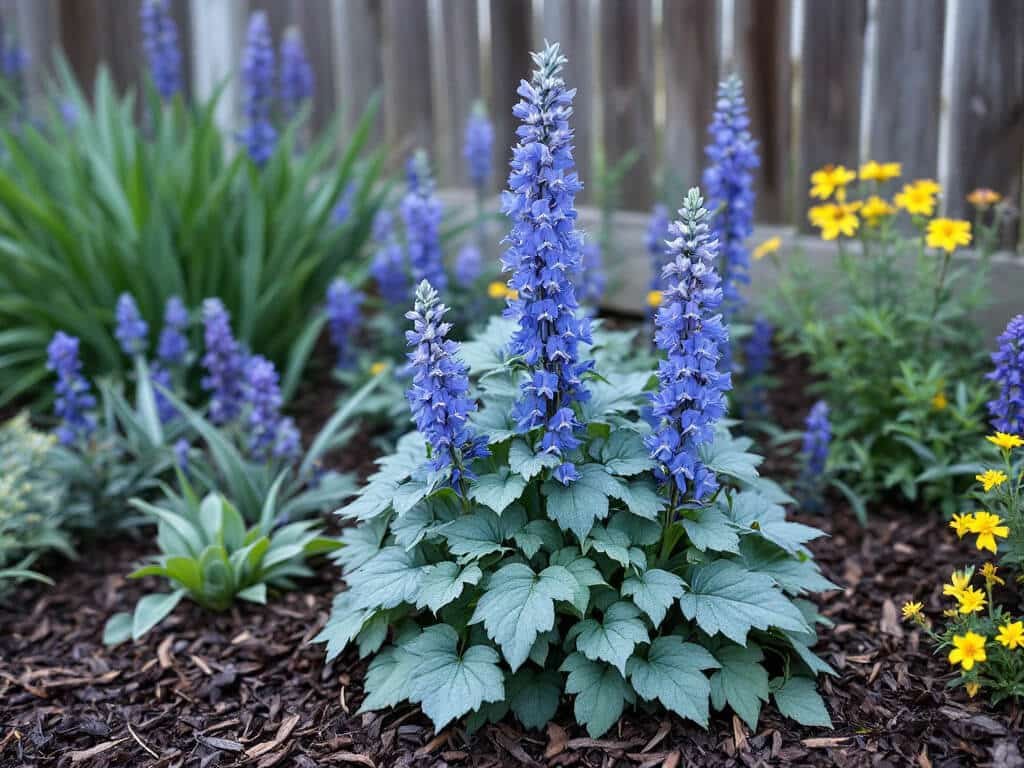
Baptisia is a long-lived perennial that tolerates poor, sandy, and clay soils as long as the site doesn’t stay waterlogged. It flowers in late spring to early summer, with exact timing depending on species, cultivar, and climate. After that you have a big, shrubby clump, so what you plant around it decides what the border looks like the rest of the season.
Pairings do three useful things here: they add contrasting form and texture, they carry interest after baptisia finishes blooming, and they fill the space around a plant that takes a few years to reach full size. They also have to share baptisia’s conditions. Poor drainage and excess moisture are the clearest causes of decline and root trouble, so a companion that wants constant watering is a problem for baptisia, not just for itself.
One myth to set aside: no extension-source evidence shows that any companion plant repels baptisia pests or improves its growth through a chemical interaction. The recommendations below are based on shared site conditions, contrasting form, and border design. Baptisia also has no major pest or disease problem consistently documented, so there is little to protect it from in the first place.
Best companion plants for baptisia
All of these suit a sunny, well-drained bed. For nearly every one, no baptisia-specific spacing figure was found, so the rule is the same: use the mature width on the plant tag and keep foliage from overlapping baptisia’s.
Siberian iris
Siberian iris likes the same sun and well-drained soil, and its upright, grassy form contrasts with baptisia’s rounded mound. The spring bloom period overlaps well. Space it by the iris’s mature spread and don’t let the two plants overlap.
Peony
Peony brings a different perennial form and a bloom sequence that works alongside baptisia in a sunny border with good drainage. Follow the peony’s mature spread, and keep its foliage from touching baptisia’s.
Ornamental grasses
Grasses add fine texture against baptisia’s leaves and extend seasonal interest, especially in a prairie-style planting. Use each grass’s labeled mature width. Taller grasses belong behind or beside baptisia.
Coreopsis
Coreopsis is listed as a compatible companion and suits sunny, relatively dry conditions, which is exactly what established baptisia prefers. Plant it by the selected variety’s mature width.
Sedum
Sedum fits a sunny, drought-tolerant scheme and works well as a lower plant near baptisia. Keep it outside baptisia’s mature 3–4 foot spread so the clump doesn’t shade it out later.
Artemisia
Artemisia offers silvery foliage that contrasts with baptisia’s blue-green leaves in a sunny, well-drained bed. Spacing depends on the cultivar, so check the mature width before you set it down.
Oenothera
Oenothera can fill lower planting space without needing consistently wet soil. That makes it a reasonable filler near baptisia. Follow the species or cultivar’s mature spread.
Senecio
Senecio is listed as a baptisia companion for a sunny border. Species vary, so confirm the mature size of the one you buy before planting, and space it by that figure.
Coneflower (Echinacea)
Coneflower suits the same sunny, well-drained, pollinator-border conditions commonly used for baptisia. Use the cultivar’s mature width and keep the plants from overlapping.
Black-eyed Susan (Rudbeckia)
Black-eyed Susan fits a sunny perennial border and complements baptisia’s flower display through the season. Follow the selected cultivar’s mature width.
Blazing star (Liatris spicata)
Blazing star gives you a contrasting vertical flower form next to baptisia’s broader shape. Use the labeled mature spacing on the plant tag.
Catmint (Nepeta faassenii)
Catmint works as a lower, front-of-border plant in a sunny, relatively dry planting. It sits in front of baptisia without competing for the same airspace. Plant it according to the cultivar’s mature spread.
What not to plant with baptisia
The problems here are mostly competition and moisture, not chemistry. None of the sources document a baptisia-specific chemical incompatibility for any plant below.
Mint (Mentha spp.)
Mint’s vigorous spreading roots can compete with baptisia for space, water, and nutrients. This is a management concern, not proven allelopathy. If you want mint, keep it in a pot away from the border.
Bee balm (Monarda spp.)
Bee balm can spread aggressively and compete for moisture and nutrients. It also generally prefers more consistent moisture than established baptisia, so the two want different watering habits.
Trumpet vine (Campsis spp.)
Trumpet vine’s vigorous growth and spreading roots can overwhelm nearby perennials. The concern is plain competition. A plant that takes years to settle in can lose that contest.
Plants that need persistently wet soil
Baptisia needs good drainage and tolerates average-to-dry conditions once established. Pair it with something that wants constantly damp soil and one of them loses. Usually it’s the baptisia, since excess moisture is tied to its root problems.
Large, closely spaced perennials
Big perennials planted tight can crowd baptisia’s mature 3–4 foot spread, cut air circulation, and compete for resources. The sources don’t name specific plants in this category, so judge by the mature size on the tag.
Layout and spacing
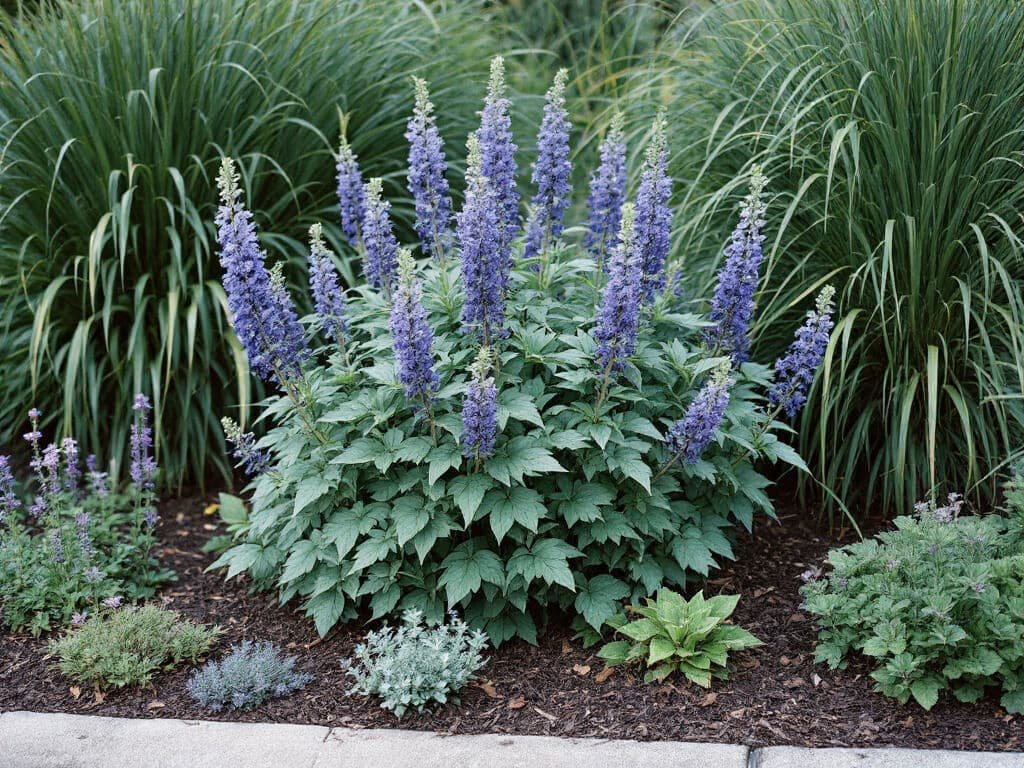
Place baptisia first, and place it where its full size won’t force a move later. It builds a substantial root system and resents transplanting, so decide on the spot before you plant, not after. Then build around it with each companion’s labeled mature width, working from tall at the back to low at the front.
– Behind or beside baptisia: taller ornamental grasses and compatible perennials such as peony or blazing star.
– Next to it at similar scale: Siberian iris, coneflower, black-eyed Susan.
– Front of the border: catmint, oenothera, and sedum (sedum outside baptisia’s 3–4 foot spread).
– Between plants: enough room that foliage doesn’t overlap at maturity.
– Baptisia itself: allow roughly 3–4 feet of space for a mature plant.
FAQ
Can baptisia grow with ornamental grasses?
Yes. Ornamental grasses are listed as baptisia companions and give contrasting texture in a sunny, well-drained border. Check the grass’s mature width so it doesn’t crowd the baptisia.
How much space does baptisia need?
Baptisia commonly reaches 2–4 feet tall with a similar spread, and one gardening source recommends spacing plants about 3–4 feet apart.
Does baptisia need companion plants?
No. It is a long-lived, adaptable perennial that grows in various soils and tolerates drought once established. Companions are mainly useful for design, seasonal succession, and filling nearby space.