
Peony Companion Plants: What to Grow Nearby
Introduction
Choosing peony companion plants comes down to two things: picking plants that want the same sun and soil, and keeping them far enough away that the peony’s foliage stays dry and open. Peonies are easy to please but prone to fungal trouble when air can’t move through them. A bad neighbor crowds the crown, holds moisture, or competes for water.
This article covers ten companions that fit peony’s conditions, the kinds of plants to leave out, and a simple layout to follow. Every companion here is chosen for shared growing conditions, a different bloom season, or the way it uses space. None is chosen for pest control, because the research doesn’t support that.
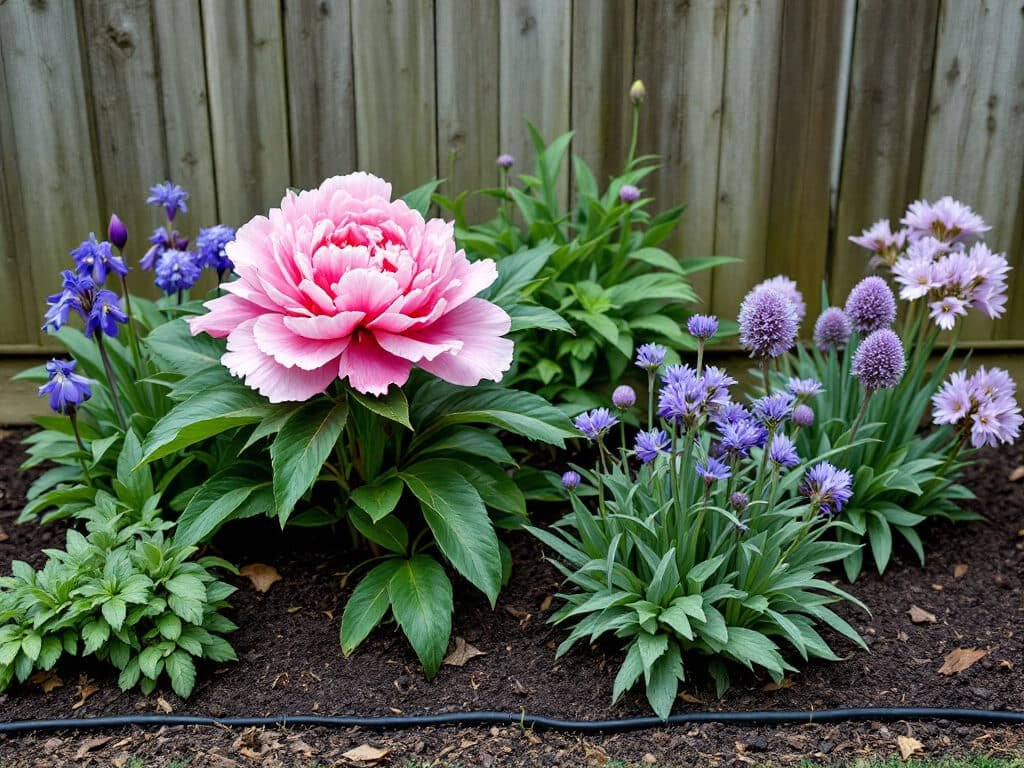
Why pairings matter for peony
An individual peony plant blooms for only about 7 to 10 days, and common garden peonies generally flower from late April through early June, depending on cultivar and location. The rest of the season you have a mound of foliage. Companions earn their place by covering the weeks before and after, with spikes, mounds, and later flowers.
Peonies grow in Zones 3 to 8 and do best in Zones 5 to 7 and northern Zone 8. They want full sun to part shade (afternoon shade helps in hot climates) and rich, fertile, medium-moisture, well-drained soil. Any companion should be comfortable in those conditions.
The bigger concern is disease. Botrytis blight, Phytophthora blight, and peony blotch all get worse with poor drainage, poor air circulation, and foliage that stays wet. Missouri Botanical Garden recommends spacing peonies at least 3 feet apart for that reason, and I’d treat that as the minimum between a peony and anything beside it. Keep companions at least 3 feet from the peony crown.
Two myths are worth clearing up. A companion plant will not cure peony disease. What the sources emphasize is drainage, air circulation, clean-up, spacing, healthy planting material, and preventive management. And ants on the buds are not a problem to solve with a neighbor plant. They commonly visit peony buds and are considered harmless.
Best companion plants for peony
All of these work at 3 feet or more from the peony. Check the mature size of your specific cultivar before you place anything, since peony size varies. Fernleaf peony typically reaches 1 to 2 feet, while common garden cultivars are larger.
Bearded iris
Bearded iris likes full sun and well-drained soil, the same as peony, so you don’t have to compromise on either. It can sit in a nearby but separate root zone. Plant it at least 3 feet from the peony.
Daylily
Daylily forms a clump and carries interest through a long season, well after peony blooms are done. It tolerates full sun to part shade and medium moisture, which matches peony closely. Keep it at least 3 feet away.
Garden phlox
Garden phlox extends the flowering display past the peony’s short bloom window and tolerates the same general sun and soil. It’s also a plant that needs air movement itself, so give it extra room, at least 3 feet from the peony and more if you can.
Siberian iris
Siberian iris adds upright foliage and flowers, and it fits a sunny, evenly moist, well-drained border. The upright blades give a contrast in shape to the peony’s rounded mound. Plant it at least 3 feet from the peony.
Catmint (Nepeta)
Catmint makes a lower edging plant for a sunny border and tolerates well-drained soil. Use it at the front of the bed, but keep it at least 3 feet from the peony so it doesn’t spill onto the crown.
Salvia
Salvia brings vertical flower spikes and works in the front or middle of a sunny border. The spikes contrast with the peony’s broad leaves. Space it at least 3 feet from the peony.
Coneflower (Echinacea)
Coneflower supplies flowers later in the season, so it picks up after the peony is finished. It occupies a different visual layer from a spring-blooming peony. Keep it at least 3 feet away.
Sedum (Hylotelephium)
Sedum provides late-season structure and prefers a sunny, well-drained spot, which suits peony. It’s a good plant to put where you want something to look at in the fall. Plant it at least 3 feet from the peony.
Allium
Allium adds spring flower form and height at the same time the peony is blooming, and it doesn’t need a dense planting right against the crown. That makes it easy to tuck in without crowding. Keep it at least 3 feet from the peony.
Hosta
Hosta can fill a part-shade edge where the peony still gets adequate light. The catch is that its foliage shouldn’t be close enough to restrict air movement around the peony. Plant it at least 3 feet away.
What not to plant with peony
The sources don’t identify any single species as a proven bad peony companion. What they identify are conditions and habits that cause trouble, so judge a plant by those rather than by name.
Plants that require constantly wet soil
Peonies need well-drained soil, and soggy ground raises the risk of root and crown disease. A plant that wants wet feet will pull the whole bed in the wrong direction. Only pair a peony with a moisture-lover if you’ve confirmed its water needs differ and you can place it where its watering won’t reach the peony.
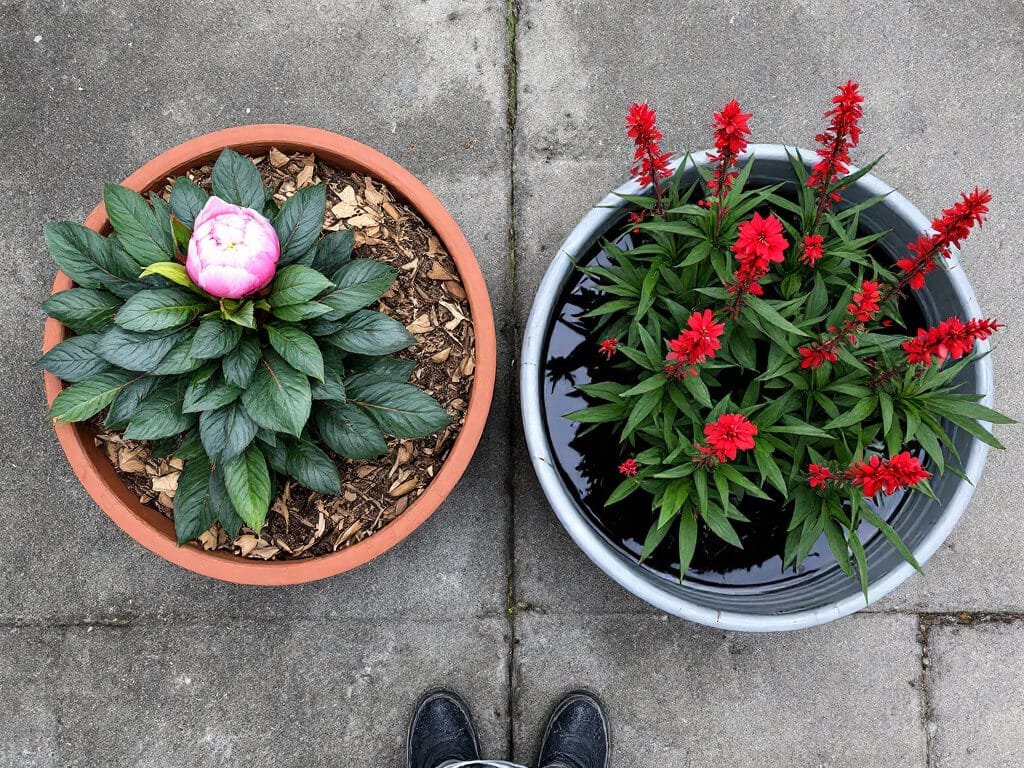
Dense, sprawling plants placed against the peony crown
Sprawlers pressed against the crown restrict air circulation and keep leaves wet longer. Those are the conditions associated with Botrytis and peony blotch. Keep at least 3 feet of separation.
Plants with aggressive, crowded root systems
Plants that spread hard by their roots compete with the peony for water and nutrients in a restricted root zone. Keep them out of the peony’s minimum spacing, or leave them out of the bed.
Plants sharing a poorly drained site
If the whole site drains badly, no companion choice will fix it. Moisture problems, especially Botrytis and Phytophthora, become more likely. Improve the drainage first, since companion planting won’t make up for it.
Layout and spacing
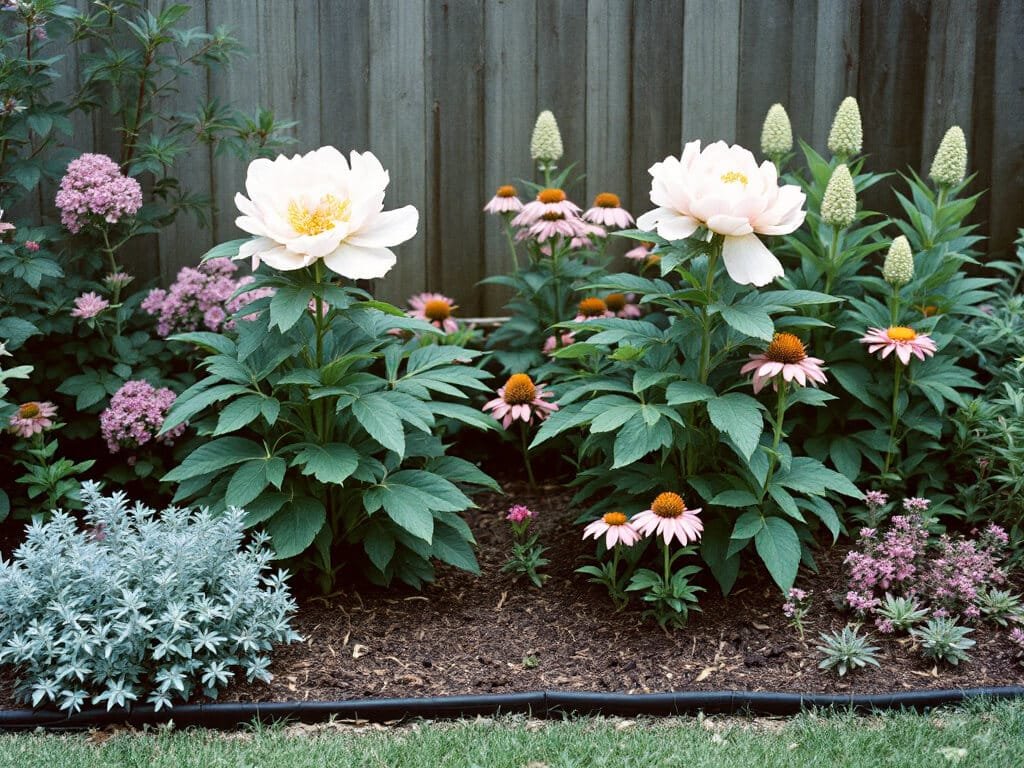
Treat peonies as widely spaced structural plants in a sunny border, with lower companions toward the front and later-blooming perennials beside or behind. Keep foliage open around each crown, and water at the soil line when you can so leaves stay dry.
– Place each peony at least 3 feet from its nearest neighbor, measured between plants.
– Put low edgers like catmint toward the front, still outside the 3-foot minimum.
– Put taller, later bloomers such as coneflower, garden phlox, and sedum beside or behind the peony.
– Use allium and salvia in the middle of the border for spring and early-summer height.
– Check the mature size of your peony cultivar and add distance for large or spreading companions.
– Leave open air around every crown so the foliage dries quickly after rain or watering.
FAQ
Can roses be planted with peonies?
The sources don’t verify roses as a special peony companion. They can work only if the site gives both plants adequate sun, drainage, room, and air circulation, so keep them separated rather than crowding their foliage.
Do peonies need a companion plant to bloom well?
No. Peony performance depends mainly on suitable light, fertile well-drained soil, adequate early-season moisture, correct planting depth, and minimal disturbance.
How far should companion plants be from peonies?
Missouri Botanical Garden recommends spacing peonies at least 3 feet apart to improve air circulation and reduce disease. Use that as a conservative minimum between an established peony and nearby companions, and go farther for large or spreading plants.