
Carrot Companion Plants: What to Grow Nearby
Choosing carrot companion plants comes down to two questions: what can share the bed without crowding the roots, and what might make carrots harder for pests to find? Carrots are deep-rooted and need to be thinned to 2–4 inches apart, so anything planted next to them has to leave that room. The good companions below are mostly shallow-rooted, quick to harvest, or kept at the bed edge.
Why pairings matter for carrot
Carrots are a cool-season crop that grows best in full sun and light, well-drained sandy loam with a pH of about 6 to 7. They are grown as an annual across USDA zones 5 to 9, with exact planting dates depending on your local climate. They want about 1 inch of water a week when rain falls short.
Crowding is the main risk with companion planting. Forked or split roots commonly come from compacted soil, rocks, crowding, or drought. A neighbor that shades the seedlings, steals water, or makes thinning awkward can cost you straight roots.
The pest side is real but modest. Root maggots, cutworms, leafhoppers, and aster yellows are the main problems for carrots. Some companions may make carrots harder for pests to locate, and flowering plants can feed beneficial insects. Companion planting does not replace crop protection or integrated pest management. Treat it as one layer, and keep plantings loose enough that you can still spot a problem when it starts.
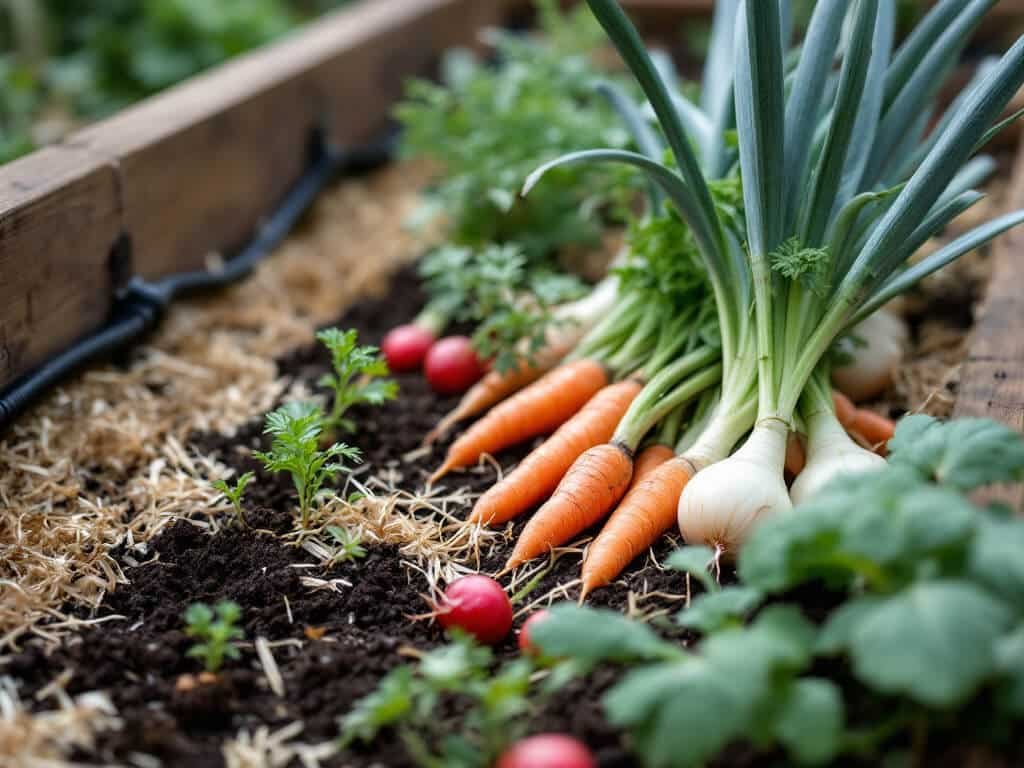
Best companion plants for carrot
Onion
Onion scent may make carrots harder for carrot fly to locate, which is why it is the most commonly recommended pairing. Plant onions alongside the carrots, not mixed into the row. Keep about 2–4 inches between carrot plants and roughly 4–6 inches between onions, depending on the onion type.
Radish
Radishes germinate quickly and mark the carrot row, so you can see where you sowed before the carrots show. Sow them in the same row or nearby. Pull the radishes while the carrots are developing, which frees up space. After thinning, keep the carrots at 2–4 inches.
Lettuce
Lettuce is an early, shallow-rooted crop that can share space with deeper-rooted carrots. The two are not competing for the same layer of soil. Leave enough room that the carrots can still be thinned to 2–4 inches, and harvest the lettuce early so it is out of the way as the carrot tops fill in.
Leek
Leek is a shallow-rooted allium that can share a bed with carrots. Space the carrots at 2–4 inches and follow the spacing recommendation for your leek cultivar, since it varies. Put leeks in an adjacent row rather than weaving them through the carrots.
Garlic
Garlic is an allium listed with carrots among cool-season crops suitable for mixed planting. Keep garlic at its recommended bulb spacing while you thin the carrots to 2–4 inches. Give it its own row next to the carrots.
Chives
Chives are an allium that may add scent diversity around carrots. Plant them in a border or a separate clump so they do not interfere when you thin. A clump at the end of the bed works well.
Cilantro
Flowering herbs can provide nectar and habitat for beneficial insects, and cilantro is listed among compatible cool-season crops. Keep it outside the carrot row and maintain 2–4 inches between carrots. It belongs at the edge of the bed.
Dill
Dill can provide food and habitat for beneficial insects when it flowers. Grow it at the edge of the bed, because its mature foliage can shade young carrots. If your bed is small, I’d put dill on the north side so its shadow falls outside the carrots.
Parsley
Parsley is a flowering herb that can increase plant diversity and may support beneficial insects. Grow it beside the carrot row, not within it, and thin the carrots to 2–4 inches. It is a good edge plant because it stays compact.
Alyssum
Alyssum nectar and pollen attract beneficial insects, but the evidence cited is for lettuce, not carrots. Use it as a nearby edging plant, and do not count on it as direct carrot-pest control. It is a low-risk filler, not a proven fix.
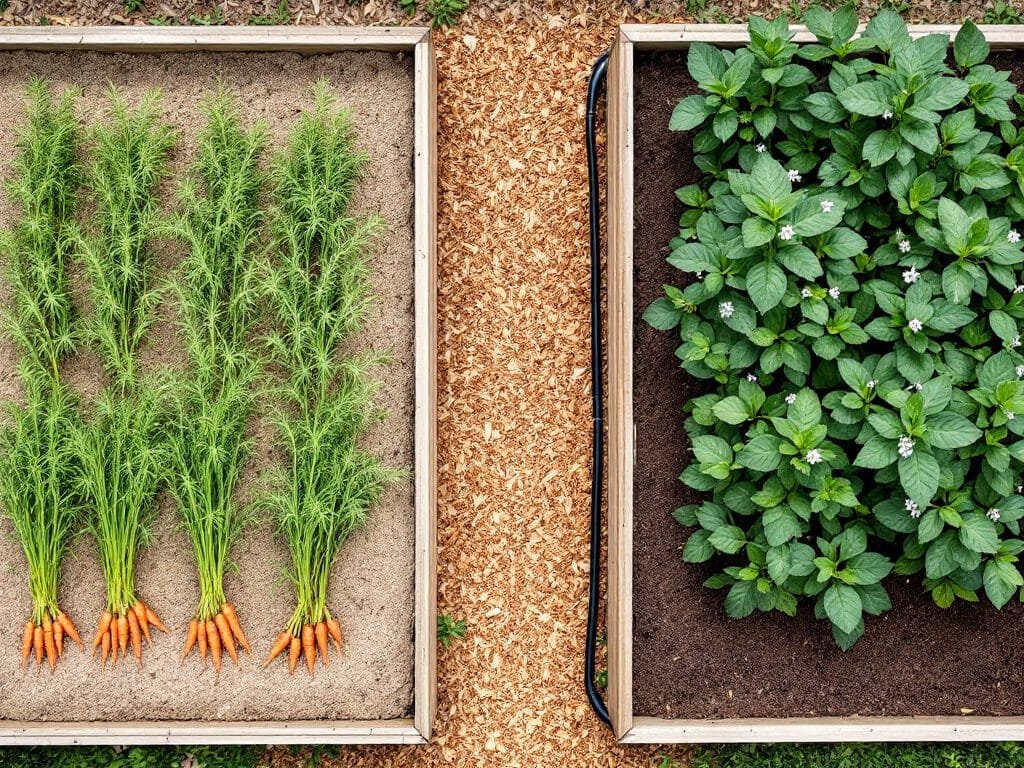
What not to plant with carrot
Fennel
Fennel can inhibit nearby plants through allelopathy, so it is not a routine carrot companion. Plant it well away from the carrot bed, in its own spot. If you already grow fennel, give it a separate bed or container.
Potatoes
Both carrots and potatoes are root or tuber crops that compete for underground space, and potatoes need substantial soil resources. Do not crowd carrots beside potato rows. Compaction and crowding are two of the known causes of forked roots.
Large, dense crops such as corn
Tall, dense crops can shade carrots and compete for water and nutrients. Carrots want full sun and steady moisture. Keep them out from under any dense canopy.
Invasive or aggressively spreading herbs
Herbs that spread aggressively can crowd carrot seedlings and make thinning and weeding difficult. If you want one nearby, use a contained clump or a separate container. The point is to keep the carrot row accessible.
Any crop sharing a known pest or disease problem
Dense plantings make diagnosis and pest management harder. If a neighboring crop is already dealing with a pest or disease, do not pack carrots in next to it. Companion planting does not replace crop protection or IPM, so leave enough room to inspect and treat.
Marigolds as pest control
The claim that marigolds reliably repel garden pests is disputed by extension guidance. Evidence is inconsistent, and multiple studies found marigolds did not deter Colorado potato beetles. Plant them if you like them, but do not count on them as a proven carrot-fly control.
Layout and spacing
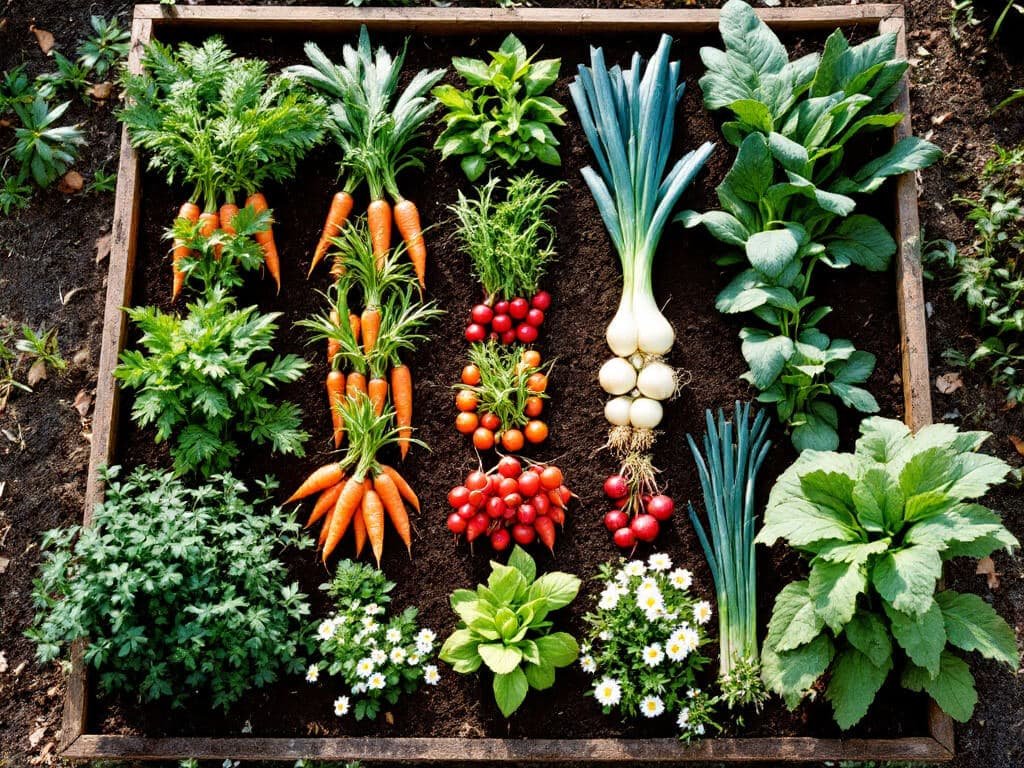
Treat carrots as the deep-rooted crop in a mixed bed and put the shallow-rooted or short-season plants around them. Keep the herbs and flowers at the edge, where they cannot shade seedlings or get in the way of thinning.
Center rows: carrots, thinned to 2–4 inches apart.
Adjacent rows: onions, leeks, or garlic, each at its own recommended spacing (onions about 4–6 inches apart).
In or beside the carrot row: radishes as a short-term marker crop, pulled as the carrots develop.
Bed edge: dill, parsley, cilantro, or alyssum, kept clear of the carrot row.
Border or separate clump: chives.
Away from the bed: fennel, potatoes, corn, and any spreading herb that is not contained.
FAQ
Do onions really repel carrot fly?
Onions are commonly recommended because their scent may make it harder for carrot fly to find carrots. Companion planting works best alongside exclusion and other pest-management practices, not as a guaranteed control.
Can radishes and carrots grow in the same row?
Yes. Radishes germinate quickly and mark the row, then you can pull them while the carrots are emerging, which gives the carrots more room.
Are marigolds proven carrot companions?
No reliable carrot-specific benefit was verified. Extension guidance notes that marigold pest-deterrent claims are inconsistent and that research has disproved some widely repeated ones.