
Cabbage Companion Plants: What to Grow Nearby
Choosing cabbage companion plants comes down to two jobs: filling the space around the heads without crowding them, and cutting back the caterpillars and beetles that chew them. A few pairings have real research behind them. Others are garden folklore that gets repeated until it sounds like fact.
This guide sticks to what extension and university sources actually support, and says plainly where the evidence is thin. Cabbage is a cool-season crop in USDA zones 5-9 that wants full sun, fertile soil and steady moisture. Everything below assumes you are growing it that way.
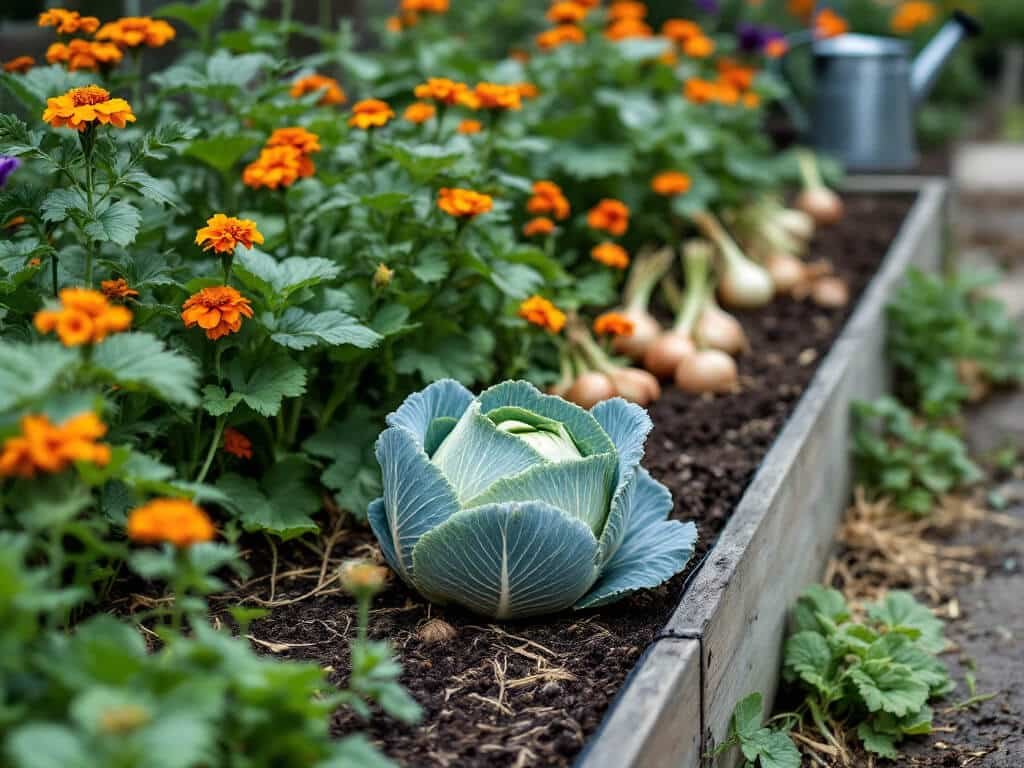
Why pairings matter for cabbage
Cabbage has a long list of pests. Cabbageworms, cabbage loopers and diamondback moth larvae chew leaves. Flea beetles pepper them with small holes, cabbage maggots go after roots, and slugs and pigeons take what is left. On the disease side you can run into Alternaria, black rot and clubroot.
Companion plants can help with some of the insect problems. The strongest evidence is an Iowa study, summarized by University of Minnesota Extension, in which onion, nasturtium and marigold each reduced cabbage looper and imported cabbageworm damage in cabbage. Some of the herb evidence comes from other crops, though: thyme and sage reduced diamondback moth numbers on Brussels sprouts in greenhouse research, and thyme also helped with cabbageworm damage in an Iowa broccoli study.
One myth is worth clearing up. You will often read that marigolds or green onions reliably repel flea beetles. University of Minnesota Extension says the research on this is limited and sometimes contradictory, so don’t count on either one.
Best companion plants for cabbage
The first five plants below have some evidence for reducing caterpillar damage. The next four are trap crops, meant to pull pests away from the cabbage rather than repel them. The last one is a groundcover. In every case, set your cabbage spacing first (12 to 18 inches between plants, depending on the cultivar) and fit the companions around it.
Onion
In the Iowa study, onion helped reduce cabbage looper and imported cabbageworm damage in cabbage. Plant onions outside the mature head space of each cabbage. Use your cultivar’s spacing, generally 12 to 18 inches between cabbage plants, and tuck the onions into the gaps beyond that.
Nasturtium
Nasturtium also reduced looper and imported cabbageworm damage in the Iowa study, and it can act as a trap crop for brassicas. Grow it at the bed edge, not inside the cabbage spacing. That keeps the trailing growth away from your heads and keeps any pests it collects off the cabbage itself.
Marigold
Marigolds reduced looper and imported cabbageworm damage in cabbage in the same study. Place them around the perimeter or in open spaces where they will not crowd the cabbage. Treat them as a modest help against caterpillars, not a flea beetle fix (see the myth above).
Thyme
Thyme reduced diamondback moth populations on Brussels sprouts in greenhouse research and helped reduce cabbageworm damage in an Iowa broccoli study. It likes drainage, so give it a well-drained edge position outside the cabbage’s 12 to 18 inch spacing zone.
Sage
Sage reduced diamondback moth populations on Brussels sprouts in greenhouse research. The evidence is not specific to every cabbage-growing situation, so keep expectations modest. Plant it where its preference for drier soil will not compete with the consistent moisture cabbage needs, which is about 1 inch of water per week when rain falls short.
Arugula
Arugula is a “spicy” brassica that can act as a trap crop for flea beetles, drawing them away from the main crop. Grow it as a sacrificial strip or a nearby succession crop. It is not a guaranteed repellent, and it needs watching (more on that in the next section).
Mustard
Mustard can also serve as a flea beetle trap crop. It is in the brassica family, though, so it can host brassica pests too. Keep it in a monitored strip and pull it out if pest pressure gets high.
Napa cabbage
Napa cabbage is another brassica reported as a flea beetle trap crop. Grow it as a separate, monitored block rather than assuming it protects every cabbage plant. I’d treat it as a decoy you have to keep an eye on, not a protective border.
Radish
Utah State University educational material reports radish as a possible trap crop for flea beetles, root maggots and cabbage maggots. Effectiveness varies by pest and site. Sow radishes in a separate nearby strip, not between cabbages, and check them often.
Clover or trefoil groundcover
A low-growing cover can make cabbage-family plants less visually detectable to cabbage root fly. Use it only where it will not interfere with cabbage establishment, irrigation or harvest. A groundcover that smothers young transplants or blocks your watering is not worth the trade.
What not to plant with cabbage
The problems here are mostly about placement and rotation. None of this proves that every mixed planting fails, but it does show where trouble builds up.
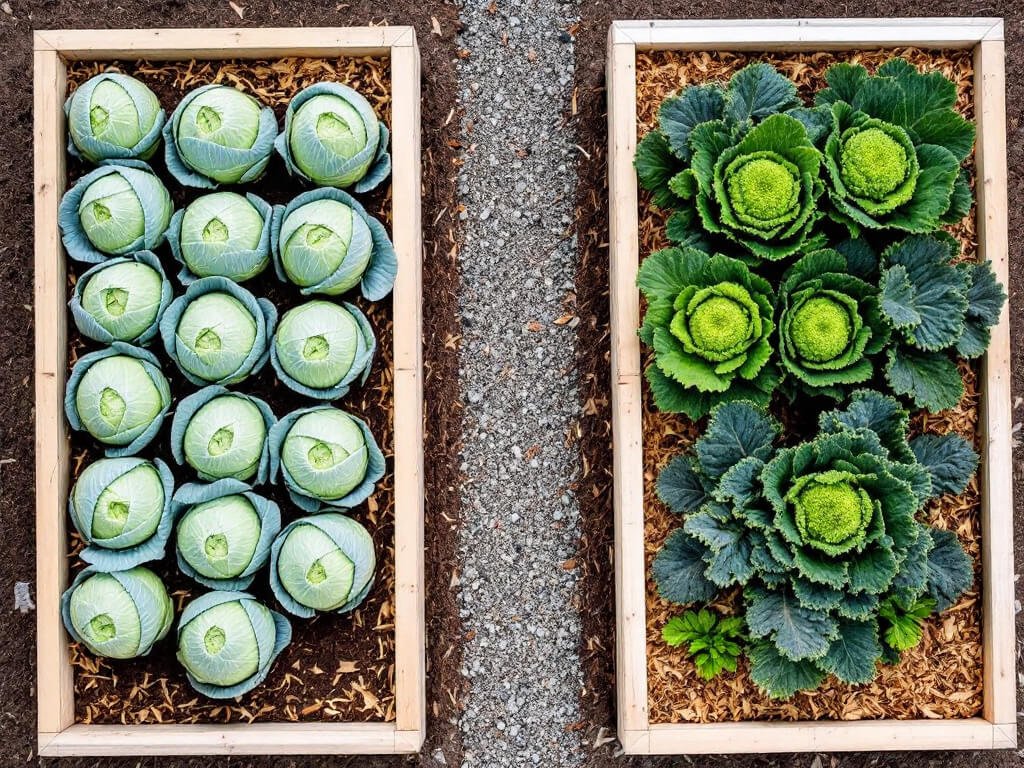
Other brassicas in the same rotation spot
Broccoli, cauliflower, kale, mustard and radish share pests and diseases with cabbage. Repeated brassica planting in the same spot can build up soil-borne problems such as clubroot and black rot. Rotate: extension guidance recommends keeping the same plant family out of a location for roughly two to four years.
Mustard or arugula without monitoring
Both can draw flea beetles away from cabbage, which is the point of a trap crop. Left unmanaged, they become pest reservoirs, and you have effectively planted a flea beetle nursery next to your cabbage. If you are not going to scout the strip, skip it.
Napa cabbage without monitoring
Napa cabbage may attract flea beetles, so it should not be treated as a maintenance-free protective companion. Plant it only if you will check it regularly and pull it when the damage climbs.
Layout and spacing
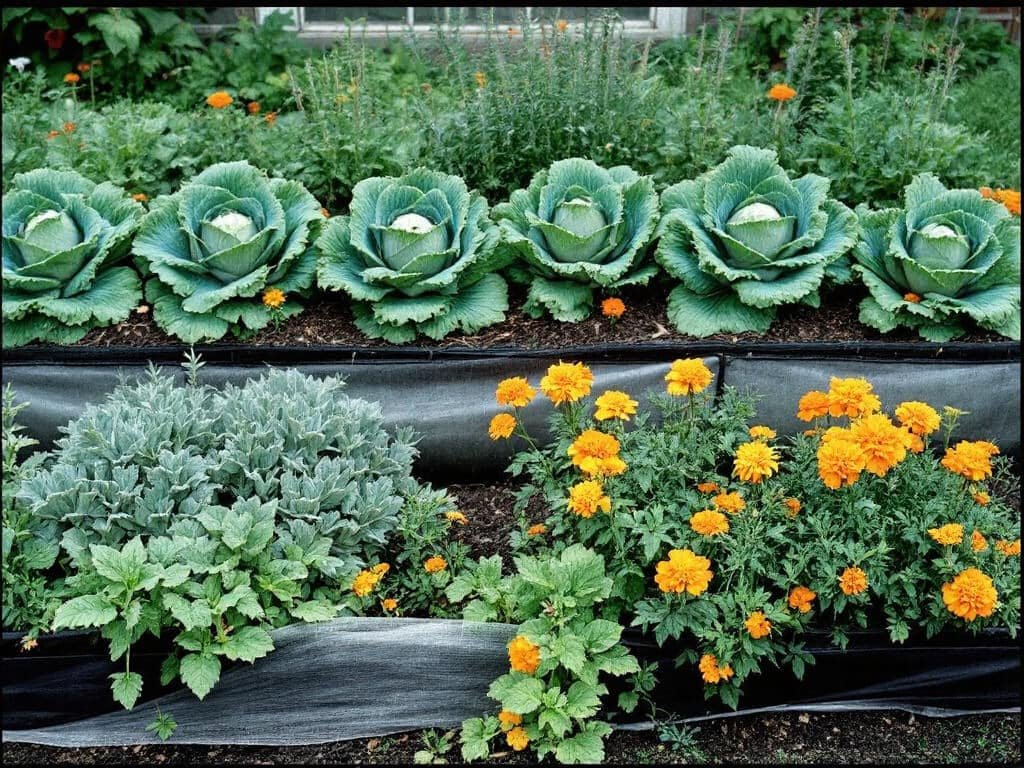
Start with the cabbage and work outward. Use the mature spacing on your seed packet, roughly 12 inches for compact varieties and up to 18 inches for larger ones, then use the remaining bed edges and open spaces for onions, herbs and flowers. Keep trap crops in their own strip where you can watch them.
Cabbage: 12 inches apart for compact types, up to 18 inches for larger types. Check the packet.
Onions, marigolds, thyme, sage: in bed edges or open spaces, outside each cabbage’s mature head space. Keep sage and thyme on the drier, well-drained side.
Nasturtium: at the bed edge, not inside the cabbage spacing.
Trap crops (arugula, mustard, napa cabbage, radish): in a separate, clearly monitored strip. Remove them if pests build up.
Clover or trefoil: only where it will not interfere with establishment, irrigation or harvest.
Water: about 1 inch per week if rainfall is short.
Row covers: over the cabbage whenever caterpillars, flea beetles or pigeons are the main problem. Companion plants are not a substitute for exclusion.
FAQ
Do marigolds reliably protect cabbage from flea beetles?
Not reliably. University of Minnesota Extension says marigolds are commonly promoted for this, but the research is limited and contradictory. The Iowa study found reduced cabbageworm damage in cabbage, which is a different claim from flea beetle control.
Can cabbage grow beside other brassicas?
They can share a bed, but they share many pests and diseases, so grouping several brassicas makes monitoring harder and lets problems build. Rotation matters most: avoid the same plant family in one spot for roughly two to four years.
Are companion plants enough to control cabbage pests?
No. Fine-mesh row covers can exclude cabbage caterpillars, pigeons and some early-season insects. Scouting and crop rotation cover the other risks.