
Celery Companion Plants: Evidence-Based Choices
Celery companion plants are worth picking with some care, but not for the reasons most garden lists give. The extension sources do name crops that sit well next to celery. What they don’t prove is that any of those crops repel celery’s pests or boost its yield.
So treat this as a guide to compatible neighbors and a sensible layout. Where a popular claim isn’t backed up, I’ll say so.
Why pairings matter for celery
Celery is a biennial grown as a cool-season annual, and it is demanding. It wants fertile soil, high and even moisture, and full sun to part shade, with some protection from excessive heat. It also takes a long time: harvest usually starts 100–125 days after sowing, depending on variety and transplant date.
That long, thirsty season is why neighbors matter. A companion that crowds celery, shades it, or needs a very different watering routine will cost you more than any pest benefit would give back. Celery also has plenty of pests to deal with already: aphids, leafminers, cutworms, armyworms, slugs, and snails. Diseases include fusarium yellows, cercospora and septoria leaf blights, pink rot, and viruses.
Here is the myth to drop. You’ll see claims that nasturtiums pull aphids off celery, that onions repel celery pests, that beans feed nearby celery with nitrogen, and that fennel stunts it. None of these were verified in the extension sources. Companion lists tell you which crops are compatible. They don’t prove a specific pest, nutrient, or yield effect for every pairing.
Pick companions for practical reasons: similar water needs, upright growth that leaves light and airflow alone, and a different plant family from celery.
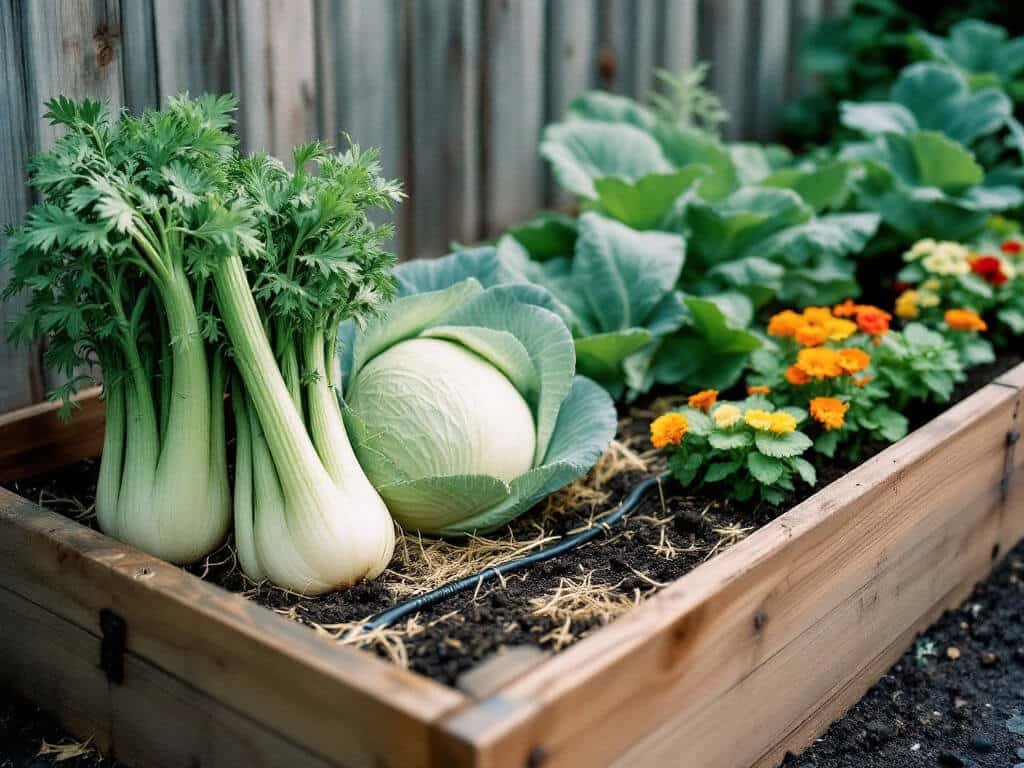
Best companion plants for celery
Virginia and West Virginia Extension list the crops below as celery companions. In every case, keep the companion outside celery’s own footprint of 6–8 inches per plant, and follow the companion’s own spacing.
Cabbage
Cabbage prefers fertile, regularly watered soil, the same as celery, so the two are easy to care for together. No celery-specific pest-control effect has been verified. Give the cabbage the larger spacing its variety calls for, and don’t squeeze celery into that space.
Broccoli
Broccoli is a compatible crop that adds diversity to the bed. It is not a proven yield booster for celery. Follow the spacing on your broccoli variety’s label, and watch the mature canopy so it doesn’t crowd the celery.
Kale
Kale falls under the same cabbage-family recommendations. It gives you another crop in the bed but no verified repellent effect on celery pests. Plant it where its mature leaves won’t block celery’s light or airflow.
Onions
Extension lists onions as a celery companion. The popular idea that onion scent protects celery from pests was not verified. Use the spacing for your onion cultivar and keep the bulbs outside the celery planting area.
Leeks
Leeks are in the onion-family recommendations and are a compatible upright crop. No controlled study showed a pest benefit for celery. Follow leek spacing and leave an accessible path between the two crops so you can water and harvest without stepping on either.
Bush beans
Bush beans are listed as a celery companion. I wouldn’t count on them as fertilizer, since no source here verifies nitrogen moving to neighboring celery in the same season. Use standard bean spacing and don’t let the plants shade the celery.
Tomatoes
Tomatoes are on the extension lists too. The real benefit is vertical space, not pest control. Stake or cage them so they stay upright, and place them where they won’t excessively shade the celery.
Nasturtiums
Nasturtiums are listed as a celery companion, but the claim that they work as an aphid trap for celery was not verified. Still, they make a reasonable border plant. Keep them at the edge so celery’s spacing and your access for watering stay intact.
Spinach
Spinach is a short-season crop, and that is its useful role here, not any biological benefit to celery. Harvest it before the foliage crowds the celery block. Keep the soil regularly moist, which suits both crops.
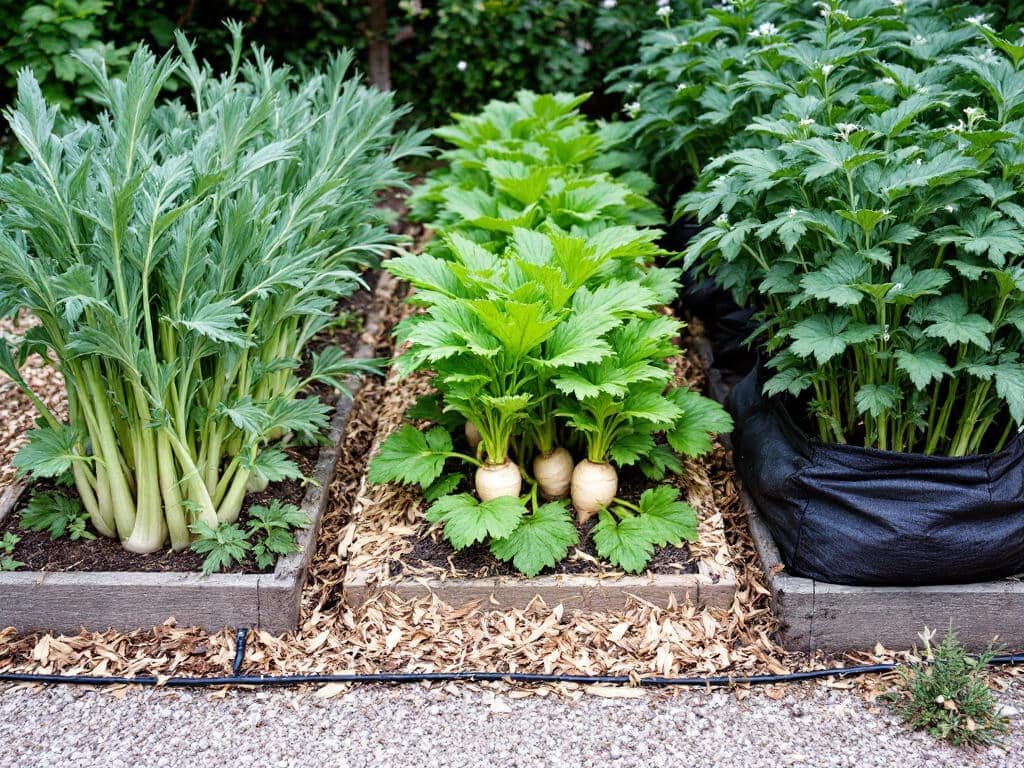
What not to plant with celery
The “avoid” list is shorter than most websites make it, and the reasons are thinner than you’d expect. Here is what the sources support.
Parsnips
Keep parsnips away from celery. Virginia Extension lists them as a plant to avoid near celery. Both are in the Apiaceae family, so separating them also helps avoid concentrating related pest and disease pressures in one spot.
Potatoes
Virginia Extension also lists potatoes as a plant to avoid near celery. The source doesn’t say whether the concern is competition, disease, or something else, so I won’t invent a reason. If you have the room, put potatoes elsewhere and leave it at that.
Carrots
Carrots are not established as harmful to celery in the allelopathic sense. But carrots and celery are both Apiaceae and can share pest and disease pressures. Separate them, and rotate so neither follows the other in the same soil.
Fennel
You’ll often read that fennel stunts celery. No reliable extension source in the available results verifies a celery-specific effect, so don’t treat that claim as established. If you want to be cautious, giving fennel its own spot costs you nothing, but you don’t need to pull it out of a bed on the strength of that rumor.
Layout and spacing
Keep celery in a block or a short row so irrigation reaches every plant evenly. Put companions along the edges, where you can reach them, rather than between celery plants. Extension guidance generally places positive companions within two or three rows of each other, but it sets no universal celery-to-companion distance.
– Space celery 6–8 inches apart within the row and 18–24 inches between rows, adjusted for variety and growing method.
– Plant tomatoes on the north side of the bed (Northern Hemisphere), staked or caged, so they don’t shade the celery.
– Use onions, leeks, spinach, or nasturtiums along accessible edges, outside the celery planting area.
– Give cabbage, broccoli, and kale their own labeled spacing, and keep their mature leaves from overhanging celery.
– Put bush beans where they won’t shade the celery as they fill out.
– Keep parsnips and carrots in a different part of the garden, and rotate them away from the celery bed.
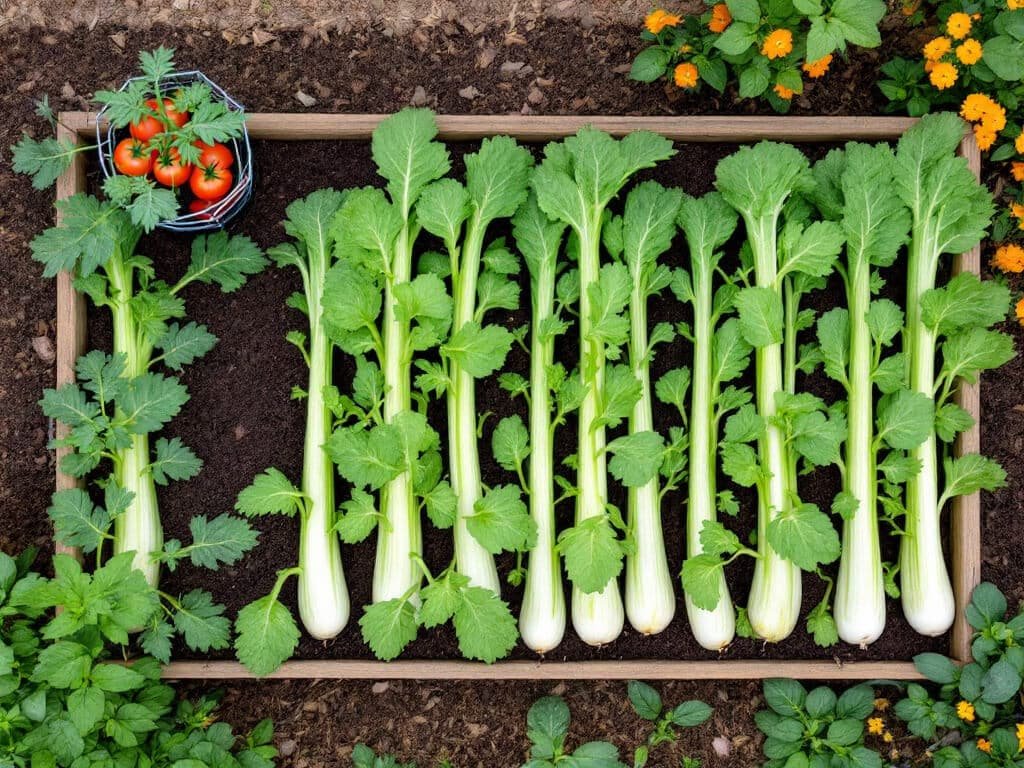
FAQ
Can celery and tomatoes grow together?
Virginia and West Virginia Extension list tomatoes as a celery companion, but the available sources don’t prove a celery-specific pest-control benefit. Stake the tomatoes and keep them from excessively shading the celery.
Can celery be planted beside carrots?
Carrots and celery are both Apiaceae and may share pest and disease pressures, so separating them is sensible. A specific allelopathic effect or yield penalty was not verified.
How much space should celery have from its companions?
Celery commonly needs about 6–8 inches between plants and 18–24 inches between rows, and each companion should be spaced for its own mature size. Positive companions are generally placed within two or three rows, but the cited sources establish no universal celery-to-companion distance.