
Turnip Companion Plants: What to Grow Nearby
Choosing turnip companion plants comes down to four jobs: making the crop harder for flea beetles to find, bringing in beneficial insects, using bed space well, and staying out of the turnip’s way. Some pairings do one or two of those jobs reasonably well. None of them do all four, and none replace watching your plants.
Turnips are a quick cool-season crop, so the best neighbors are low, open, and easy to keep apart from the root row.
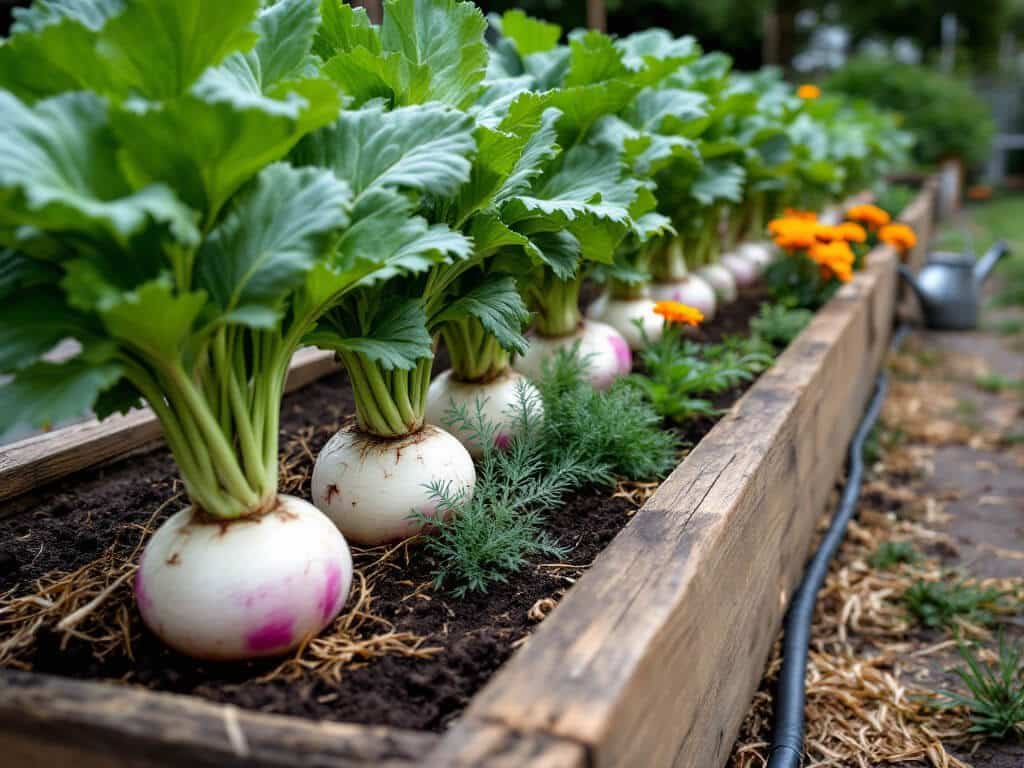
Why pairings matter for turnip
Turnips are in the mustard family (Brassicaceae), and that comes with a familiar list of troubles: flea beetles, cabbage maggots (also called root maggots), Alternaria leaf spot, black rot, and clubroot. A pure block of turnips is easy for those pests to work through. Mixing in other plants is meant to make the crop less obvious, and that is the best-supported reason to bother. Utah State University’s flea beetle guidance lists companion crops as one tool for this.
No companion plant has been shown to reliably repel all turnip pests. Utah State University points out that many companion-planting recommendations rest on folklore, and that documented effects tend to be minor and dependent on the situation. Treat companions as one layer of pest management, alongside rotation, spacing, and checking your leaves regularly.
The other reason pairings matter is the turnip’s own needs. It wants full sun, about 1 inch of water a week, and loose soil, because the roots form close to the surface. A companion that shades the row, crowds the roots, or forces you to dig near them will cost you more than it gives back.
Best companion plants for turnip
The list below runs roughly from the better-supported picks to the more speculative ones. In every case, keep turnips at 3–6 inches apart in the row and put the companion beside the row, not inside it.
Bunching green onions
Green onions may help make turnips less apparent to flea beetles when grown as an intercrop. Space the turnips 3–6 inches apart and follow the onion seed packet for spacing between onion rows so the two crops are not fighting for the same ground.
Dill
Utah State University lists dill as a companion crop used in flea beetle management, and it can also support beneficial insects. Plant it beside the turnip row rather than within it, since the turnips need their close, even spacing.
Marigold (Tagetes spp.)
Marigolds may contribute to pest management and add plant diversity, which can make a host crop less apparent to flea beetles. Use the marigold’s mature spread to decide how far from the turnip row to plant it. Think of it as a diversity plant, not a repellent.
Garlic
Strongly scented plants like garlic are described as potential pest deterrents, though a turnip-specific repellency result was not verified. Plant garlic far enough from the row to keep the 3–6 inch turnip spacing intact.
Chives
Chives are another strongly scented allium discussed as a possible pest-deterring plant. Use them as a border or a nearby clump along the row edge. Don’t let the clump creep into the space the turnip roots need.
Nasturtium
Nasturtium adds floral diversity and can attract beneficial insects. The sources do not verify a turnip-specific pest-control effect, so treat it as a biodiversity companion and not a guaranteed repellent.
Thyme
Thyme is a strongly scented herb used in companion-planting examples, and it may add insect habitat. Keep it at the edge of its mature spread so it does not crowd the turnip row.
Oregano
Oregano produces compounds with insecticidal activity in the companion-planting material I’m working from, but that evidence is not specific to turnips. Plant it outside the turnip row and leave room for its mature spread.
Peas
Peas are also a cool-season crop, and they can use vertical or seasonal space without sharing a root row with turnips. Put the pea trellis on the side of the bed, and keep the turnips at 3–6 inches apart. Make sure the trellis does not shade the turnip row.
Carrots
Carrots and turnips are both cool-season root crops, so they suit space-efficient mixed cropping. Keep the seedlings separate so each crop can be thinned according to its own seed packet. I’d sow them in neighboring rows, not mixed in one.
What not to plant with turnip
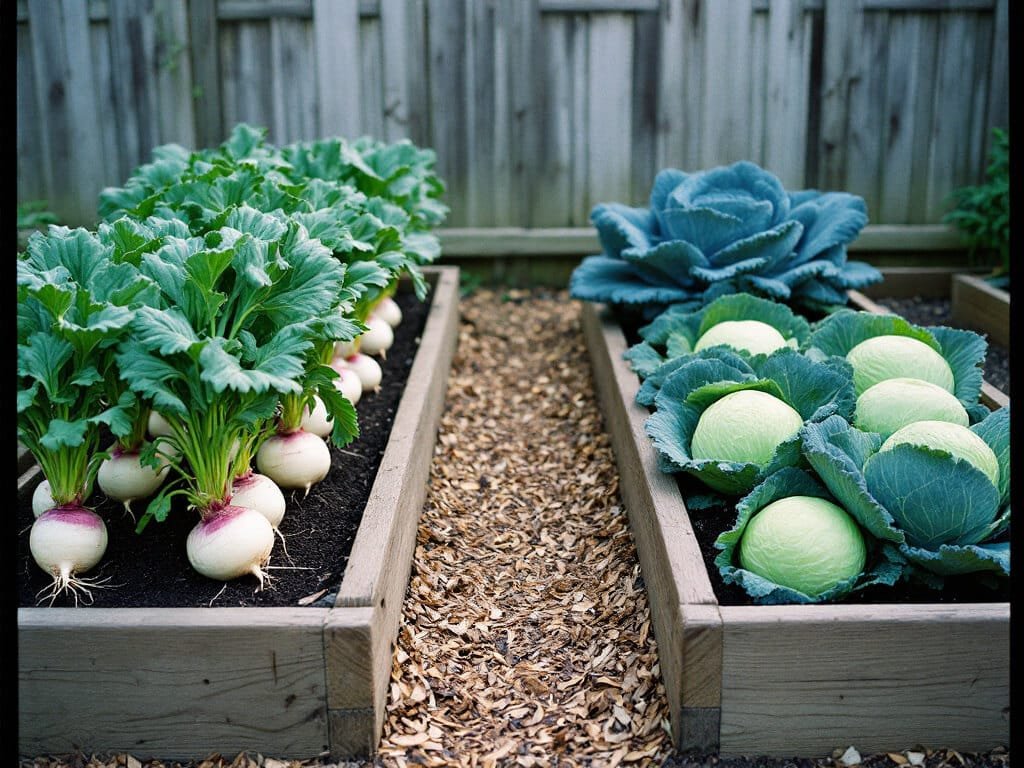
No turnip-specific plant has been reliably verified as a bad companion through allelopathy, mismatched water needs, or a proven disease interaction. What follows are practical cautions, not firm prohibitions.
Other Brassica crops (cabbage, broccoli, kale, radish)
These share important pests and diseases with turnips, including flea beetles and several soilborne and leaf problems. Grouping them concentrates hosts in one spot. Rotate Brassica crops from year to year instead of relying on close interplanting.
Anything planted too tightly
Crowding by any species means competition for sunlight, water, and nutrients, and it can hinder root development. Hold the 3–6 inch spacing between turnips, and don’t let a companion shade the row. Crowding also gets in the way of the shallow cultivation turnips need to avoid root damage.
Large, vigorous crops such as squash
Squash takes up a lot of ground and can shade or overrun a turnip planting. No turnip-specific incompatibility was verified, so the issue is size, not chemistry. Plant them near each other only if you can harvest the turnips before the squash canopy closes. With spring sowings starting around April 15 in the Minnesota guidance, that timing can work, but check it against your own frost dates.
Layout and spacing
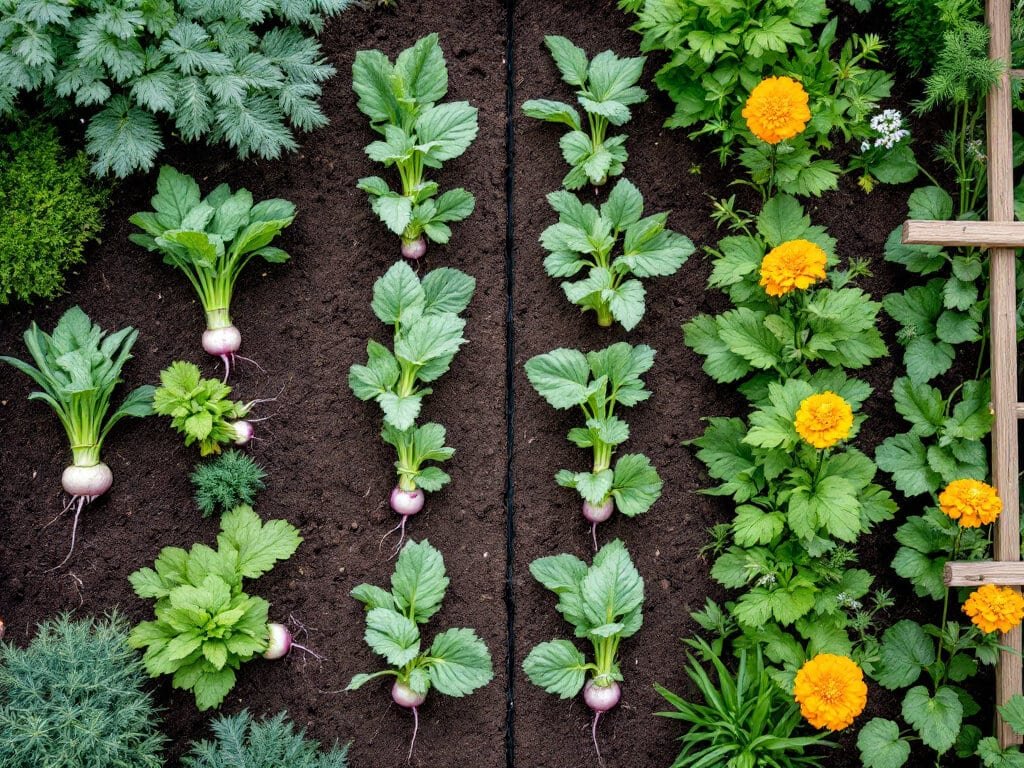
Give turnips their own dedicated row, then put low, open companions along the edge. Taller or spreading plants go on the north side where possible, so they don’t throw shade on a cool-season crop.
– Turnips: thin to 3–6 inches apart in the row. Sow seeds 1–2 inches apart first, then thin.
– Row spacing: commonly 18–30 inches apart in the cited extension guidance.
– Row edge: bunching onions, dill, or chives, kept clear of the turnip roots.
– North side: peas on a trellis, or other taller plants.
– Further out: marigold, nasturtium, thyme, and oregano, spaced by their mature spread.
– Containers: one turnip row or block, with herbs around the perimeter, not dense roots mixed into the same limited soil.
FAQ
Can I plant turnips with other Brassicas?
Turnips can grow near other Brassicas, but they share pests and diseases such as flea beetles and several disease problems. Crop rotation and avoiding overcrowding are more dependable precautions than assuming a companion effect.
Do marigolds repel turnip pests?
Marigolds are among the plants used in companion and flea beetle management strategies, but the sources do not establish reliable, turnip-specific repellency. Use them to increase plant diversity, not as a substitute for monitoring and integrated pest management.
How much space do turnips need?
Sow seeds 1–2 inches apart, then thin seedlings to 3–6 inches apart. Rows are commonly 18–30 inches apart in the cited extension guidance.