
Rose Companion Plants for a Healthy, Longer-Blooming Garden
Choosing rose companion plants means solving two problems at once: you want something growing around the rose, but anything planted too close competes with it and blocks the air it needs. Most advice skips the second half. The plants below work because they fit the rose’s needs for sun, drainage, and open space, and each one comes with a minimum distance.
Roses are long-lived woody shrubs and climbers, so whatever you plant beside them will share that spot for years. It’s worth getting the pairing and the spacing right the first time.
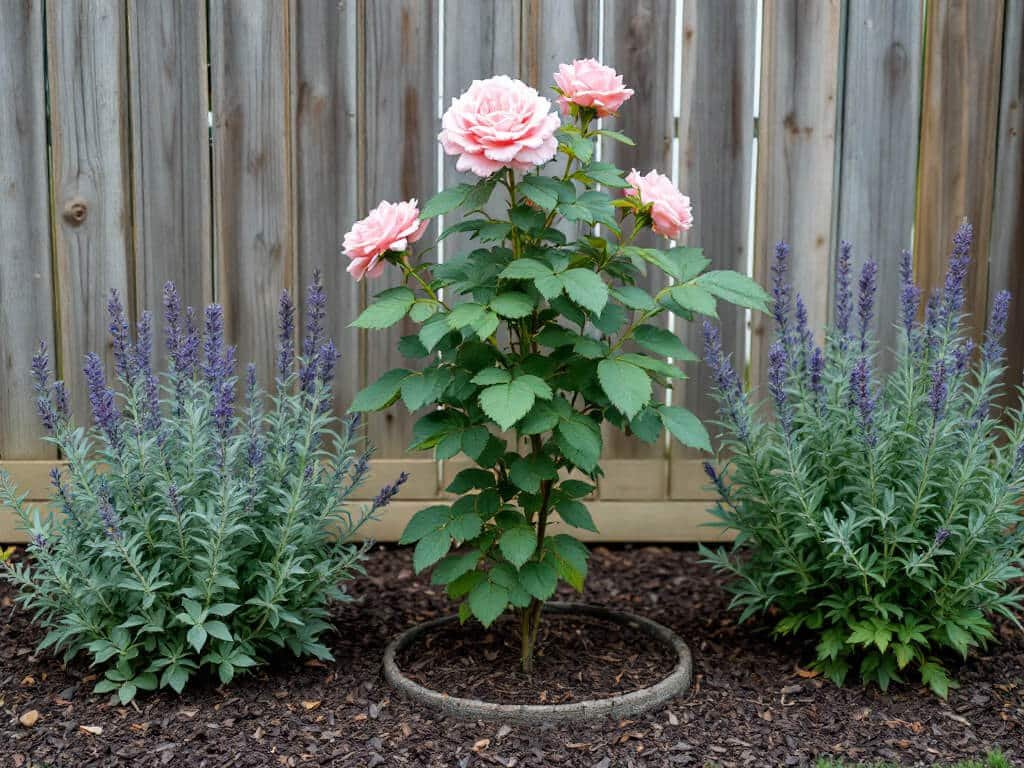
Why pairings matter for rose
A rose is a full-sun plant that wants fertile, well-drained soil with regular moisture. It usually blooms from spring or early summer into fall, depending on the cultivar and whether it repeats. Size varies enormously, from miniatures to big shrub and climbing types, and hardiness varies with the cultivar. Many landscape roses suit zones 5 to 9, but the plant label gives the real range.
Companions earn their place in three ways. They add color and texture around the rose, they cover the bare lower stems many roses develop, and they extend the display with different shapes and bloom times. A planting with more than one kind of plant in it also just looks less like a row of sticks with flowers on top.
What they don’t do is replace rose care. Aphids, black spot, and mildew are the usual problems, and the better-supported defenses are open spacing, good pruning, and air circulation. Pick companions that protect those three things and you’re ahead.
Best companion plants for rose
Every plant here goes at least 12 inches from the rose base. The New York Botanical Garden recommends that distance so you don’t disturb rose roots and so air keeps moving. Go farther for large or spreading plants, and base the exact distance on the mature width of both the rose and the companion.
Catmint (Nepeta)
Catmint blooms for a long stretch in blue-purple and has aromatic foliage, which pairs well with most rose colors. Keep it at least 12 inches from the rose base.
Lavender (Lavandula)
Lavender gives you contrasting foliage and flowers, and it shares the rose’s need for sun and well-drained soil. Don’t put it in the rose’s wettest root zone. Keep it at least 12 inches from the base.
Lady’s mantle (Alchemilla)
This is a low mound that softens the front of a rose planting without crowding the rose’s central crown. It’s a good choice for the edge of the bed. Plant it at least 12 inches from the rose base.
Hardy geranium (Geranium species)
The mounding foliage can disguise bare lower rose stems. Choose a nonaggressive cultivar and leave room for airflow. Keep it at least 12 inches from the rose base.
Salvia (Salvia species)
Salvia’s long-lasting flower spikes add seasonal color and can attract pollinators. Put taller forms behind the rose rather than inside its crown. Let the mature widths of both the salvia and the rose set the spacing, with a minimum of 12 inches from the rose base.
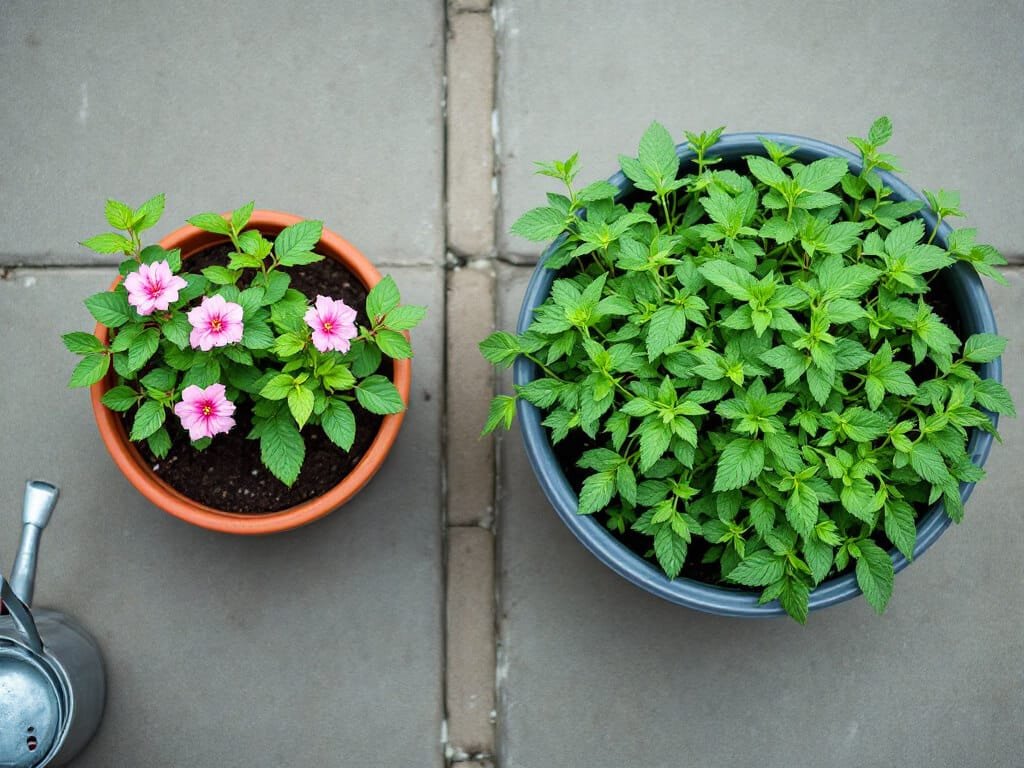
Alliums (Allium species)
Ornamental alliums extend the display and add vertical contrast with their flower heads. Plant the bulbs outside the rose’s immediate root crown, at least 12 inches from the base.
Phlox (Phlox species)
Phlox adds another flowering layer, but it’s the one on this list where cultivar choice matters most. Use mildew-resistant cultivars where you can find them, and don’t crowd the planting. Follow the cultivar’s mature width, with at least 12 inches from the rose base.
Speedwell (Veronica species)
Speedwell’s upright flower spikes sit in a different visual layer from the rose’s rounded form. Pick a cultivar whose mature width fits your bed. Keep it at least 12 inches from the rose base.
Daylily (Hemerocallis species)
Daylily’s arching foliage can cover lower rose stems. Dwarf forms create less root competition, so I’d choose those next to a smaller rose. Plant at least 12 inches from the base.
Chives (Allium schoenoprasum)
Chives make a fine-textured, edible edging with flowers. Use them as a low border, not tucked against the rose crown. Keep them at least 12 inches from the base.
What not to plant with rose
The bad pairings are less about specific species and more about behavior. If a plant grows aggressively, wants different water, or holds humidity against the rose, it’s the wrong neighbor.
Aggressive, spreading plants
Anything that can’t be contained at its mature size will crowd the rose and take water and nutrients from it. Check how a plant spreads before you buy it, not after it has moved in. If you can’t picture where it will stop, leave it out.
Plants with incompatible water needs
Roses want regular moisture, and some companions do poorly in consistently moist soil. A dry-soil specialist placed inside the rose’s irrigated root zone will struggle, and you’ll end up either overwatering it or underwatering the rose. Match the water needs, or plant the dry-soil plant outside the area you irrigate.
Dense, mildew-prone plants against the rose
Thick, mildew-prone plants packed tightly against a rose restrict airflow and keep the foliage humid. Since black spot and mildew are the rose’s main disease problems, this is the pairing to avoid most firmly. Keep the rose crown open and prune for circulation.
Garlic as a rose-pest remedy
Gardeners do sometimes plant garlic near roses hoping to deter pests. The Royal Horticultural Society treats this as a hoped-for effect, not a dependable, established result. Grow garlic if you like garlic, but don’t count on it to protect the roses.
Layout and spacing
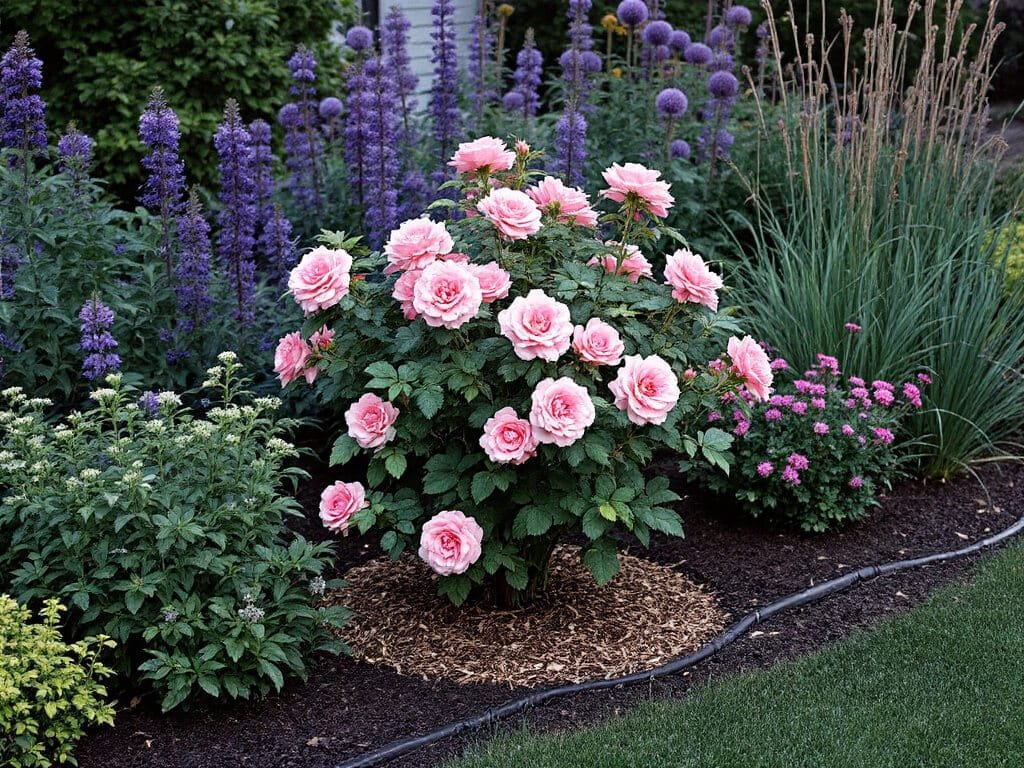
Put taller plants behind or beside the rose and shorter, mounding plants toward the front. Leave the crown open so you can prune and air can move through. Start at 12 inches from the rose base and add distance when the companion or the rose is large.
- Back or side of the rose: taller salvia forms and alliums, planted outside the crown
- Front of the bed: lady’s mantle, hardy geranium, and chives as a low edge
- Mid-layer: catmint, lavender, phlox, speedwell, and dwarf daylilies, spaced by mature width
- Around the base: nothing within 12 inches, so roots stay undisturbed and air circulates
- Wet spots: keep lavender out of the rose’s wettest root zone
FAQ
How close can companion plants be to roses?
The New York Botanical Garden recommends at least 1 foot from the rose, so the roots aren’t disturbed and air circulation is maintained. Increase the distance for large or spreading plants.
Do companion plants prevent black spot or mildew on roses?
Companion plants may help create a diverse planting, but they do not replace rose care. Open spacing, good pruning, and air circulation are the better-supported ways to reduce disease pressure.
Does garlic reliably repel pests from roses?
It’s a widely repeated claim, but the RHS describes garlic near roses as a hoped-for effect, not a dependable one. Don’t rely on it in place of checking your roses for aphids and disease.