
Watermelon Companion Plants: What to Grow Nearby
The hard part of choosing watermelon companion plants is that the vines want a lot of room, full sun, and steady water, so anything you tuck in nearby either helps by staying out of the way or hurts by competing. Most of the plants worth growing here are small, flowering, or fast, and they live at the edges of the bed rather than under the vines. The plants to avoid are mostly watermelon’s own relatives.
This guide covers what to put beside watermelon, what to keep away, and how to lay it all out so the melons still get the space they need.
Why pairings matter for watermelon
Watermelon is a warm-season annual vine that wants full sun, fertile and well-drained soil, and about 1–2 inches of water per week. Anything you plant next to it should not shade it, drink from the same shallow water, or share its pests. That rules out more than you might expect.
There’s also the pollination angle. Watermelon fruit set depends on insect visitors, and fruits generally mature 35–45 days after flowering. Flowers near the bed give bees and other beneficial insects a reason to hang around, which is the most defensible reason to plant companions at all.
Now the myth. Extension sources don’t verify that any particular flower, marigolds included, reliably repels watermelon pests. They also don’t verify that any specific “bad companion” harms watermelon through allelopathy (chemical warfare through the soil). Companion planting does not replace crop rotation, sanitation, row covers, irrigation management, or evidence-based pest control. Treat these pairings as a way to use space sensibly, not as pest protection.
One more caveat: no extension source I could verify gives watermelon-specific spacing for any of these companions. The placements below come from the plants’ growth habits and from watermelon’s own spacing needs.
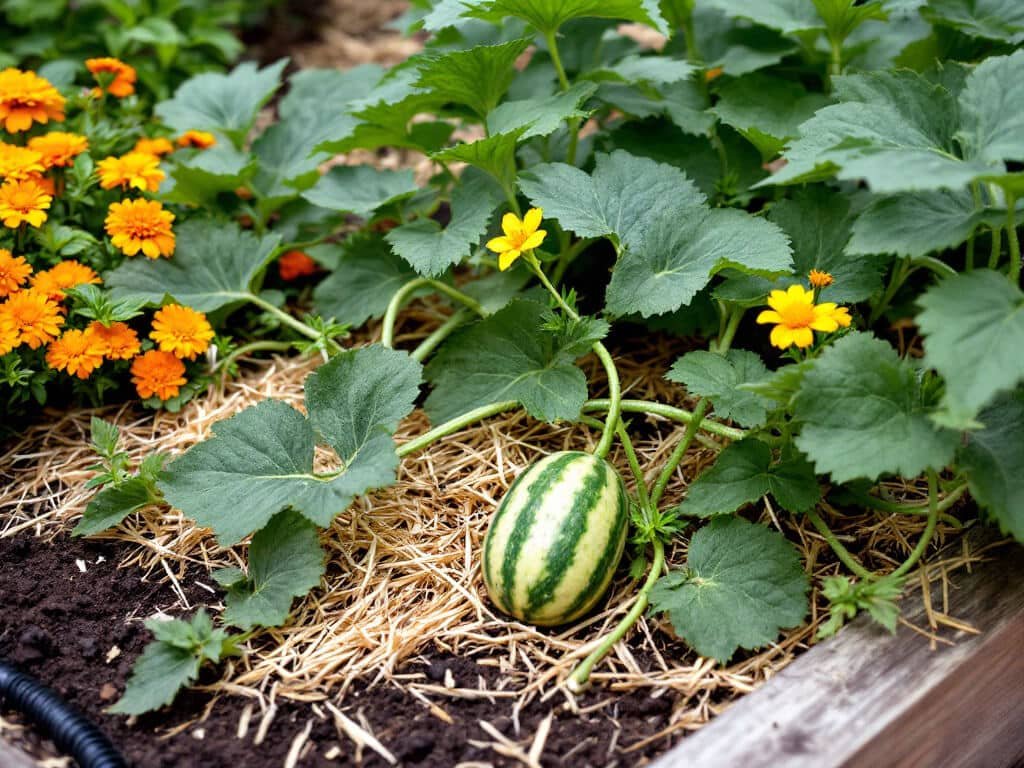
Best companion plants for watermelon
The first seven are flowers and herbs for the bed edge. The last five are crops and tall plants that fit around the vines.
Basil
Basil attracts flowering-insect visitors and grows mostly upward, so it doesn’t fight watermelon’s surface-running vines for ground. Keep it at least 12 inches from the watermelon crown. That’s the one firm number the brief gives for any companion.
Calendula
Calendula’s flowers can support beneficial insects near the crop. Plant it at the bed edge, outside the 3–6 foot area each watermelon plant needs.
Marigold
Marigolds add flowering habitat in a compact upright form. Put them at the bed edge and don’t let them cut into the vine area. Grow them for the flowers, not for pest repelling, because that claim isn’t backed up.
Nasturtium
Nasturtium gives insect visitors flowers and works well in an edge spot or a container beside the bed. Keep it outside the main vine path so the runners don’t smother it, or the other way around.
Borage
Borage supplies bee-attractive flowers, which matters because watermelon can’t set fruit without pollination. Place it at the bed edge, away from the crown and the moving vines.
Dill
Dill flowers can provide habitat for beneficial insects, and the plant takes up vertical space rather than ground. Put it at the edge, outside the vine zone.
Cilantro
Cilantro supports beneficial insects best when you let it bloom. Plant it at the bed edge and pull it if it starts crowding the vines.
Lettuce
Lettuce is short-season and shallow-rooted, so it can use the bed before watermelon vines spread. The catch is water: it can’t compete with the melons for it. Harvest it before the vines cover the bed.
Radish
Radishes are quick enough to finish before watermelon runners expand. Sow them in the early-season gaps and harvest before the watermelon canopy gets dense.
Bush beans
Bush beans grow more upright than watermelon and do fine in a nearby, separate row. Keep that row outside the watermelon’s 3–6 foot spacing zone so the two aren’t sharing root space.
Sunflower
Sunflowers add height and pollinator flowers, but they’re the one companion that can shade a sun-loving crop. Plant them on the north side of the bed so their shadow falls away from the vines.
Sweet alyssum
Sweet alyssum stays low, so it provides nearby insect habitat without building a tall canopy. Use it as a bed-edge planting, not within the crown or the main vine path.
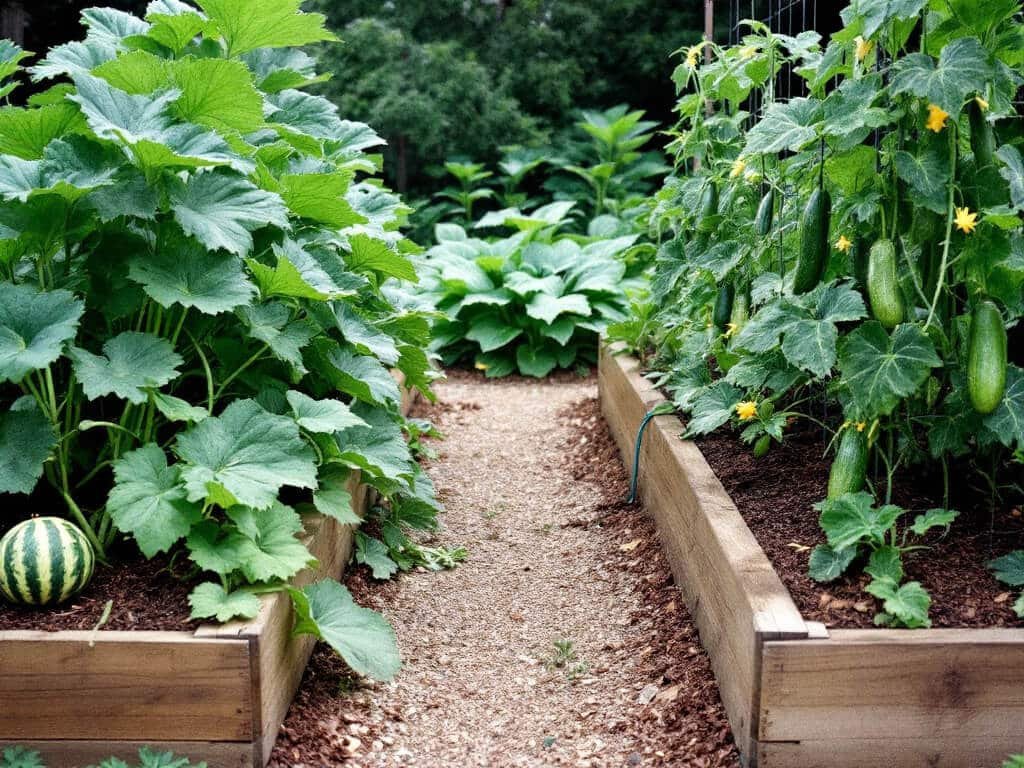
What not to plant with watermelon
The common thread here is shared pests and diseases. Watermelon is a cucurbit, and its worst problems (cucumber beetles, squash bugs, bacterial wilt, and several fungal diseases) are shared by the rest of the family.
Cucumber
Cucumbers share cucumber beetles and bacterial wilt risk with watermelon, along with other cucurbit pests and diseases. Plant them together and a problem on one crop moves easily to the other, and it gets harder to tell what’s going on when you scout.
Muskmelon and cantaloupe
Muskmelon shares many insect and disease problems with watermelon and has similar space demands. Crowd them and they compete for light and nutrients.
Squash and pumpkins
Squash and pumpkins share cucumber beetles, squash bugs, vine borers, and several diseases with watermelon. Their sprawling growth also competes with watermelon for space and water, so even without the pest overlap they’re a poor fit for the same patch.
Other watermelon plants planted too closely
This one catches people out. Watermelons crowded together compete with each other for light and nutrients, and growth and development suffer. If a spacing recommendation looks generous, it’s because the vines really do run that far.
Tall, dense plants placed south of watermelon
This is a layout problem, not a chemical one. A tall, dense planting on the south side will shade a crop that needs full sun. Put tall things north of the watermelon, never south.
Layout and spacing
Start with the watermelon and fit everything else around it. Each plant needs its full vine area, and the companions only get what’s left over at the edges or in the gaps before the vines run.
– Space watermelon plants 3–6 feet apart, and keep rows or major vine paths 6–12 feet apart where you have the room.
– Plant flowering companions (calendula, marigold, nasturtium, borage, dill, cilantro, sweet alyssum) at the bed edges, outside the vine area.
– Keep basil at least 12 inches from the watermelon crown.
– Sow lettuce and radish where you can harvest them before the vines spread.
– Put sunflowers on the north side of the bed so they don’t shade the melons.
– Give bush beans their own nearby row, outside the 3–6 foot plant-spacing zone.
– Keep cucumbers, other melons, squash, and pumpkins in a separate bed.

FAQ
What is the best companion plant for watermelon?
No single best companion was verified by the extension sources reviewed. Choose flowering plants for nearby insect habitat, or short-season crops you can harvest before the vines spread, and make sure the watermelon keeps its space and sunlight.
Can watermelon be planted with cucumbers or squash?
They can share a garden, but they also share cucumber beetles, bacterial wilt, squash bugs, and several diseases. Separate placement, adequate spacing, crop rotation, and regular scouting make the problems easier to manage.
How much space does watermelon need?
Extension guidance runs about 3–6 feet between plants and 6–12 feet between rows. Exact needs depend on the variety and how you’re growing it.