
Arborvitae Companion Plants for Healthy Garden Beds
Choosing arborvitae companion plants mostly comes down to one problem: the ground under and around an arborvitae is shady, dry-ish, and crowded with roots. Most of what you’d plant in a normal bed will struggle there. Pick plants that match the conditions at soil level, not the ones you’d like to see, and the bed works. Ignore that, and you’ll be replacing plants every year.
This article covers which plants tolerate the spot, which ones to skip, and how to lay out the bed so nothing fights the arborvitae for water.
Why pairings matter for arborvitae
Arborvitae (most commonly eastern arborvitae, Thuja occidentalis) is an evergreen that wants moist, fertile, well-drained soil and consistent water. It is not drought-tolerant, especially while it’s getting established and during dry spells. Whatever you plant nearby is competing with it for that moisture, and the arborvitae roots usually win.
Size matters too, and it varies a lot by cultivar. ‘Holmstrup’ stays around 5 feet tall and 3 feet wide, ‘Little Giant’ reaches about 4 by 4 feet, and larger forms get 20 to 30 feet tall with a 5 to 10 foot spread. A mature, dense arborvitae casts deep shade underneath, while a young or small one leaves more light. Look at your actual plant before you choose companions.
Arborvitae does best in full sun and tolerates light or partial shade. Heavy shade makes it loose and open, so don’t solve a shady bed by crowding it with taller plants either.
One myth to clear up: no extension evidence turned up showing that any companion plant repels arborvitae pests or improves its growth. Bagworms, scales, spider mites, and the rest won’t be kept off by a clever pairing. What extension guidance does support is matching light, moisture, mature size, and root competition. That is the whole job here.
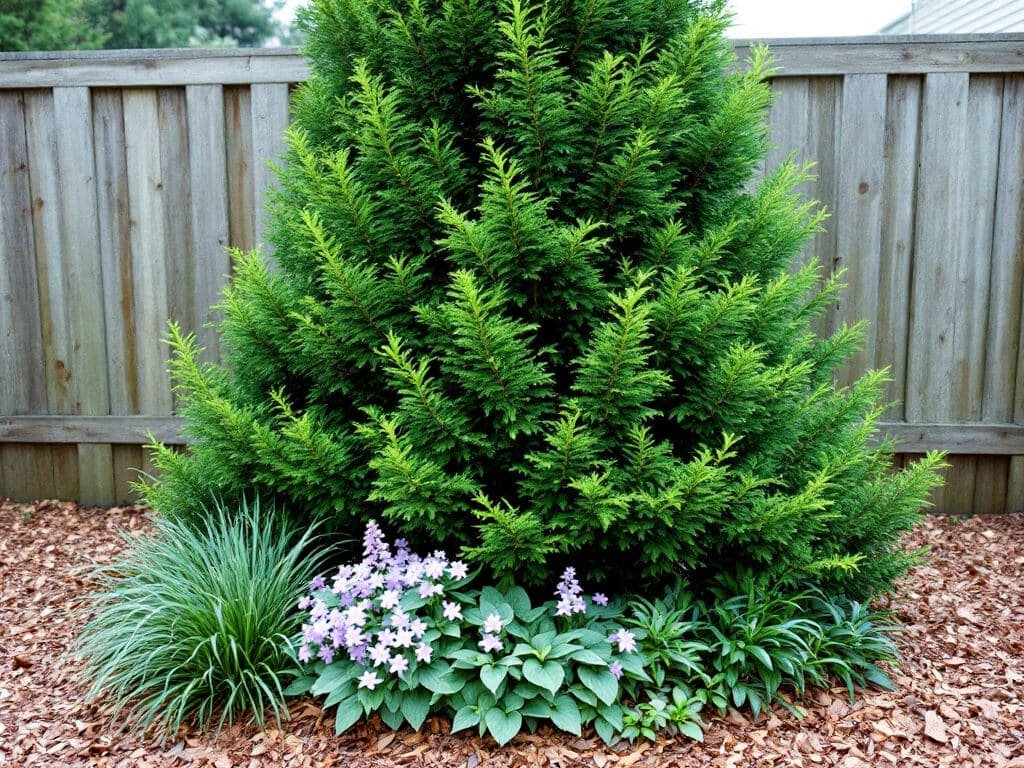
Best companion plants for arborvitae
Everything below is a shade-tolerant, lower-layer plant. None of them will do anything for the arborvitae itself. They fill the bare, difficult ground beneath it and handle the shade and root competition. No universal spacing has been verified for any of them, so the rule throughout is the same: space by the plant’s mature width on its label, and keep every planting outside the trunk flare.
Check hardiness tags too. Common eastern arborvitae cultivars generally grow in zones 3 to 7, and cultivar hardiness varies, so confirm the tag on your specific plant and on each companion.
Pennsylvania sedge (Carex pensylvanica)
This is the one I’d start with. It tolerates the dry shade and root competition you get beneath established arborvitae, and as a low ground cover it covers soil without competing for the arborvitae’s height or canopy space. Place it outside the root flare and follow the mature width on the label.
Dead nettle (Lamium spp.)
A shade-tolerant ground cover that extension guidance suggests for planting beneath mature arborvitae. It stays in the lower layer and fills in bare soil. Use the mature spread on the tag for spacing and keep it clear of the trunk.
Woodland phlox (Phlox divaricata)
Woodland phlox tolerates the shade under arborvitae and adds seasonal flowers, which is more than most plants in this spot can offer. Arborvitae itself has no showy bloom, so this is where your color comes from. Space it by the cultivar’s mature spread.
Hostas (Hosta spp.)
Hostas tolerate dense shade and fit the lower planting layer well. Because cultivar size ranges widely, space by the mature width of the hosta you buy, not by a fixed distance from the arborvitae. Expect to water them if the bed is dry, since the arborvitae will be pulling moisture too.
Ginger (Asarum spp.)
A shade-tolerant foliage plant identified as an option beneath mature arborvitae. It’s a good pick where you want leaf texture rather than flowers. Keep planting pockets outside the trunk flare and follow the label for mature width.
Hardy geraniums (Geranium spp.)
Certain hardy types tolerate the light and moisture conditions beneath arborvitae, which is why the wording matters: not every geranium will cope. Read the tag for shade tolerance before you buy, and use the cultivar’s mature width for spacing.
Other shade-tolerant woodland perennials
The principle is broader than this list. Plants matched to the shade you actually have are a better fit than sun lovers under dense arborvitae. If you find another woodland perennial that handles shade and some dryness, judge it on those two things and space it by its own mature size.
What not to plant with arborvitae
Most of the bad pairings come down to light and water. Arborvitae takes plenty of both from the surrounding bed.
Sun-loving annuals and perennials
Dense arborvitae shade can block enough light to starve them, particularly beneath mature plants. They’ll stretch, flower poorly, and fade. If you want sun lovers, they belong on the sunnier outer edge of the planting, not under the canopy.
Drought-intolerant plants in un-irrigated beds
Arborvitae roots compete strongly for moisture. A plant that wilts when the soil dries out will wilt constantly here unless you water it. If you won’t irrigate the bed, leave these out.
Large, thirsty shrubs planted tightly against arborvitae
Close planting increases competition for water and root space, and mature size has to be part of the decision. A shrub that looks fine at nursery size can crowd the arborvitae in a few years. Give big shrubs room by their mature dimensions, not their pot size.
Plants that need poorly drained soil
This one catches people. Arborvitae likes moist soil, so it’s tempting to pair it with bog or wet-soil plants. But arborvitae wants moist, well-drained soil, and persistently boggy ground is unsuitable for it. Don’t create a wet spot to suit a companion.
Plants that share unmanaged, pest-prone conditions
Arborvitae can host bagworms, scales, spider mites, and other pests. A dense, stressed planting makes those harder to spot and deal with. Keep the bed open enough that you can look at the foliage and check for problems.
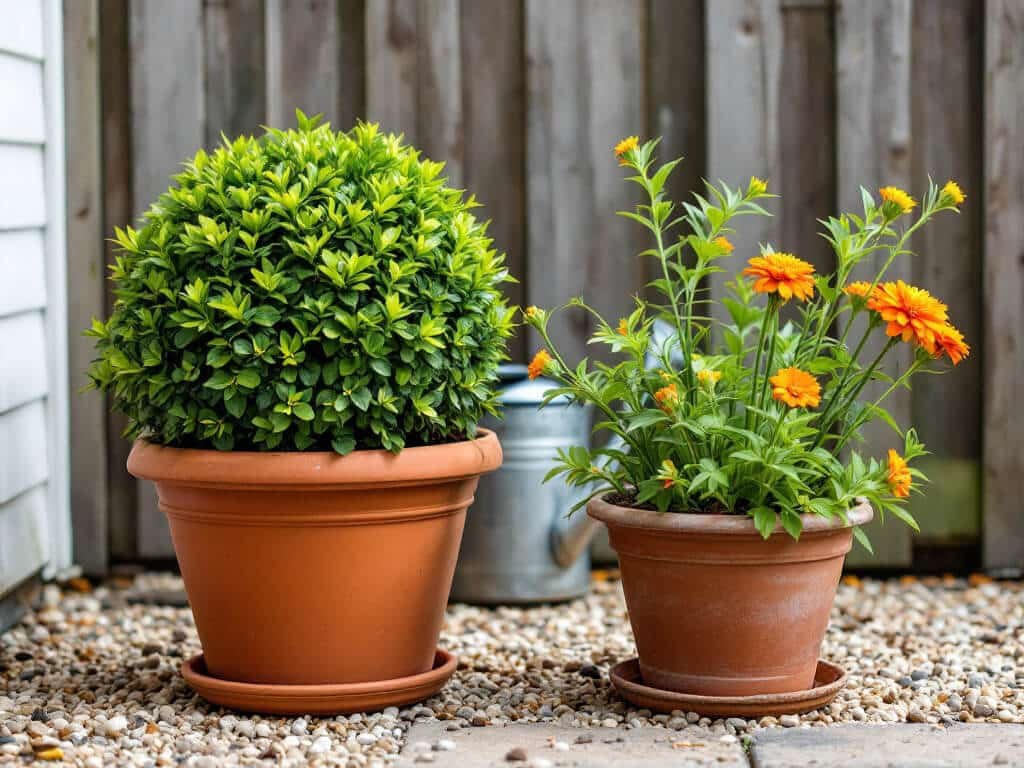
Layout and spacing
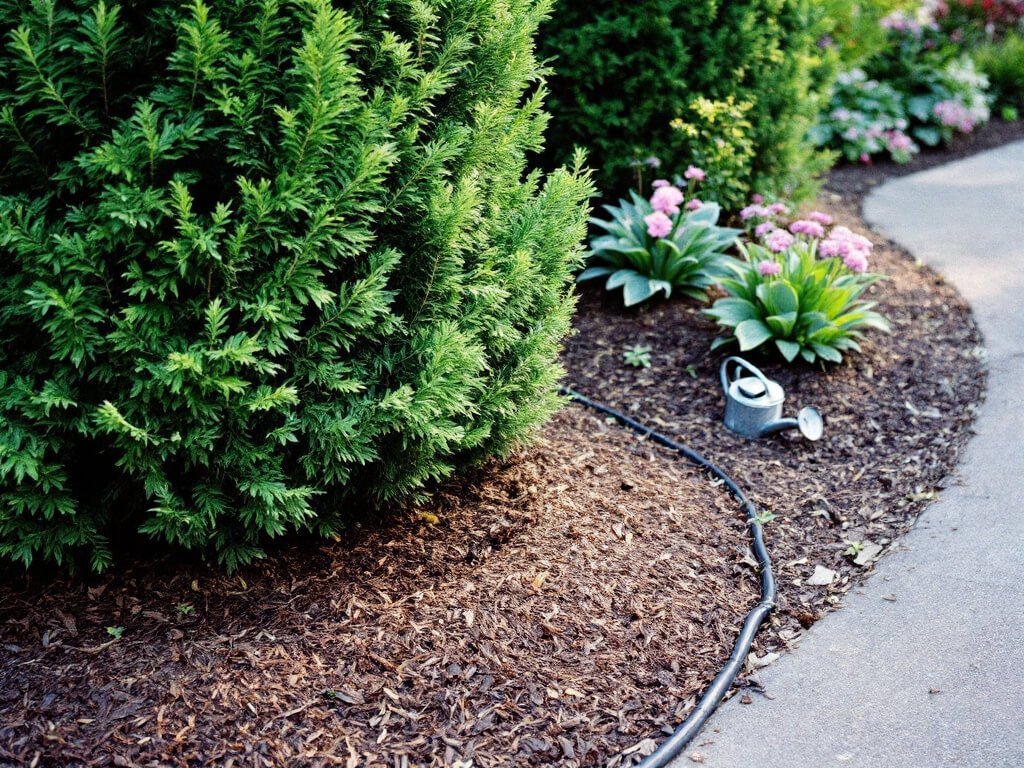
Treat the arborvitae as the structural upper layer and put shade-tolerant plants around it, not against it. Because the roots compete hard for moisture, leave planting pockets between major roots instead of digging through them. Do not pile mulch against the trunk; mulch the bed, and pull it back from the base. If companions start to wilt, water them.
– Plant outside the trunk flare, never against the trunk.
– Choose low, shade-tolerant ground covers or woodland perennials for the lower layer.
– Space each companion by its own mature width, since no single distance works for every cultivar.
– Dig small pockets between major roots rather than clearing large areas.
– Mulch the bed, keeping it off the trunk.
– Add supplemental irrigation when companions show wilting.
– Keep enough open space that you can inspect the arborvitae foliage.
FAQ
What grows well underneath mature arborvitae?
University of Wisconsin Extension identifies Pennsylvania sedge, dead nettle, woodland phlox, hostas, ginger, and certain hardy geraniums as possibilities. Success can still be difficult because arborvitae create dense shade and compete strongly for moisture, so you may need to water.
Can sun-loving flowers grow beside arborvitae?
They may grow on the sunnier outer edge of the planting, but dense arborvitae canopies reduce light beneath mature plants. Choose companions by the actual light at ground level, not by the site’s full-sun rating.
How far should companion plants be planted from arborvitae?
No single spacing applies to every arborvitae cultivar or perennial. Arborvitae size varies widely, so use each companion’s mature width, allow the roots room to grow, and keep plants away from the trunk flare.