
Rhubarb Companion Plants: What to Grow Nearby
Rhubarb companion plants are harder to choose than most lists make it sound. The crown takes up about 3 by 3 feet for years, and most of the pest-repelling and yield-boosting claims you’ll read have never been tested. What you can count on is plain spacing, light, and water.
This guide covers what to plant near rhubarb, what to keep away, and how to lay it out so nothing crowds the crown. It’s written for gardeners in zones 5 through 9, where rhubarb is commonly grown (it’s hardy to Zone 4).
Why pairings matter for rhubarb
Rhubarb is a long-lived perennial that wants full sun, well-drained soil amended with organic matter, and about 1 inch of water a week during the growing season. It gets very large. Anything you plant too close ends up in its shade or fighting it for room.
That makes “companion” mostly a siting question. A good neighbor is a plant that is happy with full sun, doesn’t need the soil kept differently, and stays outside the rhubarb’s footprint. A bad neighbor either shades the crown, crowds it, or harbors the pests that already bother rhubarb: rhubarb curculio, stalk borers, and slugs.
Now the myth. People repeat that garlic, strawberries, onions, or brassicas repel rhubarb pests or boost yield, but no controlled trials back that up. Extension guidance puts sun, drainage, spacing, and removing curly dock well ahead of any companion effect, and I’d follow that order.
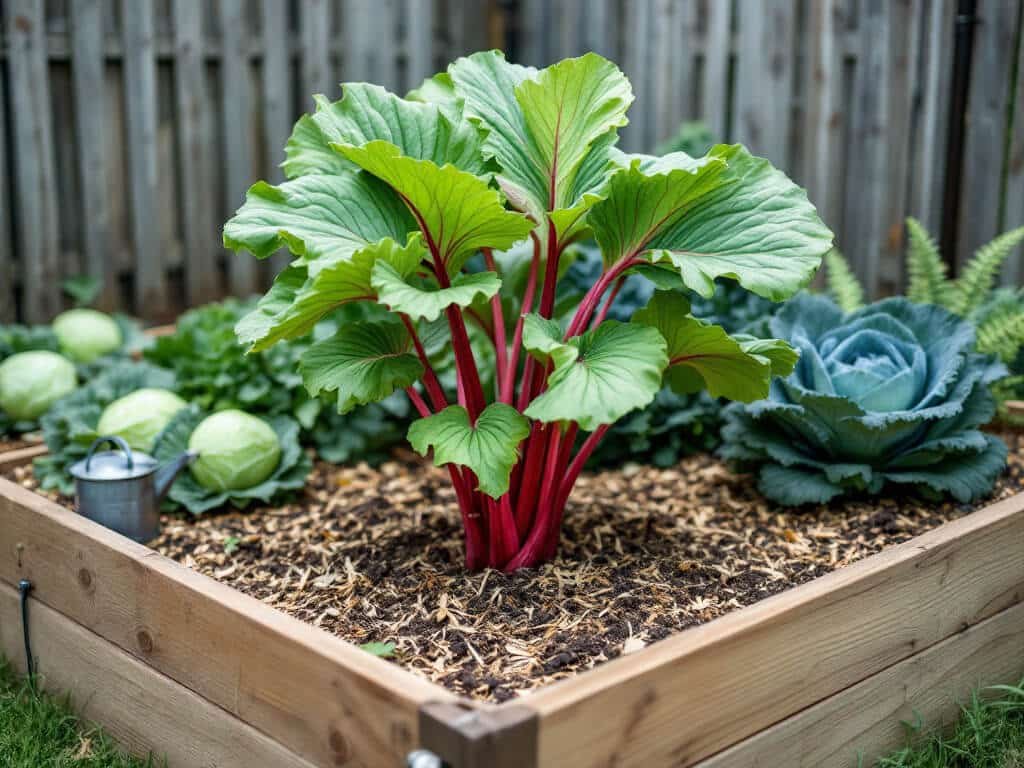
Best companion plants for rhubarb
None of these has a proven biological benefit for rhubarb. They earn their place by sharing the same sun and bed conditions and by being easy to keep out of the crown’s way. Where the brief has no tested spacing, I say so rather than guess.
Asparagus
Asparagus is another long-lived, full-sun perennial that wants a permanent bed, so the two suit the same kind of garden spot. The benefit is compatible siting, not pest control. Give each its own dedicated space with room to grow. No rhubarb-specific spacing has been verified, so keep it well outside the rhubarb’s 3-by-3-foot area.
Horseradish
Horseradish is a permanent perennial too, and Cornell lists it as a compatible crop. No measured yield benefit exists. Plant it outside rhubarb’s 3-by-3-foot growing area and contain it, because horseradish spreads and will wander into the crown zone if you let it.
Cabbage
Cabbage is a commonly recommended brassica neighbor, though no controlled rhubarb-specific benefit has been found. Its practical value is that it’s a seasonal crop you can tuck beside the perennial. Plant it outside the 3-by-3-foot area so the leaves don’t crowd the crown.
Broccoli
Broccoli works as a seasonal crop if it gets enough sun and space. There’s no rhubarb-specific pest benefit on record. Use the outer edge of the rhubarb planting area, not the crown zone.
Kale
Kale is listed alongside the other brassicas as a compatible neighbor. What you get is seasonal space sharing, not a proven mutual effect. Keep it far enough away that the rhubarb still has full sun on all sides.
Cauliflower
Cauliflower can share a bed as long as it doesn’t compete with the established perennial. Plant it outside the 3-by-3-foot area. No rhubarb-specific spacing has been verified, so err on the generous side.
Strawberry
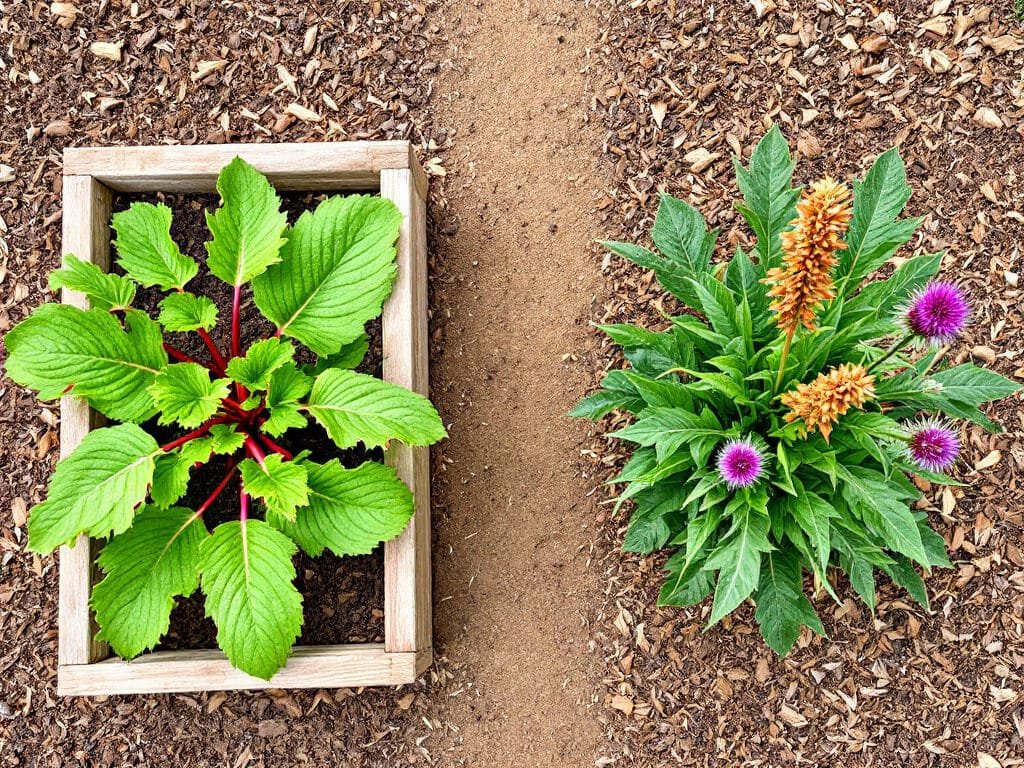
Gardeners often describe strawberries as a rhubarb companion, but extension sources found no reciprocal pest or yield benefit. If you want both, grow strawberries in a separate border or a container. Don’t put them under the rhubarb canopy, where they’ll lose light.
Garlic
Garlic is sometimes said to deter rhubarb pests, and that claim is unverified. It also needs strong, consistent light, which a big rhubarb plant will cut off. If you grow it nearby, leave generous separation and don’t plant it tightly around the crown.
Onion
Onions show up on a lot of companion lists, but no rhubarb-specific benefit or tested spacing has been verified. Grow them in a sunny spot outside the rhubarb’s dedicated space. Treat them as a neighbor in the same garden, not a partner.
Short-season vegetables
Early crops can use the ground near rhubarb before its foliage fills out. That’s a space-management trick, not a biological partnership. Pick crops that finish before the rhubarb shades them, and keep them outside the 3-by-3-foot crown area.
What not to plant with rhubarb
The “don’t” list is shorter and better supported than the “do” list. Most of it comes down to rhubarb curculio hosts and plain crowding.
Curly dock
Remove curly dock from and around the rhubarb planting. It’s a normal host for rhubarb curculio, so leaving it nearby raises the odds of beetle damage. This is the one change on this page with solid extension backing, so check the edges of the bed and the ground around it.
Thistle
Thistle can also host rhubarb curculio. Don’t grow it on purpose near rhubarb, and pull any volunteers that show up in the bed.
Volunteer sunflowers
Virginia Cooperative Extension guidance, as summarized in the research, says volunteer sunflowers can host rhubarb curculio. If sunflowers seed themselves near the rhubarb, pull them. Sunflowers planted elsewhere in the yard aren’t the issue; the ones next to the crown are.
Garlic planted tightly around rhubarb
Dense rhubarb foliage shades garlic and can interfere with bulb development. This is a light problem, not allelopathy (a chemical effect between plants). Separate the two generously, or grow the garlic in its own sunny bed.
Any tall, vigorous crop inside the crown space
Rhubarb needs about 3 by 3 feet for itself, and a tall or fast-growing crop inside that square competes for light and room. Keep tall crops outside it. If a plant will be taller or bulkier than the rhubarb by midsummer, it belongs somewhere else.
Layout and spacing
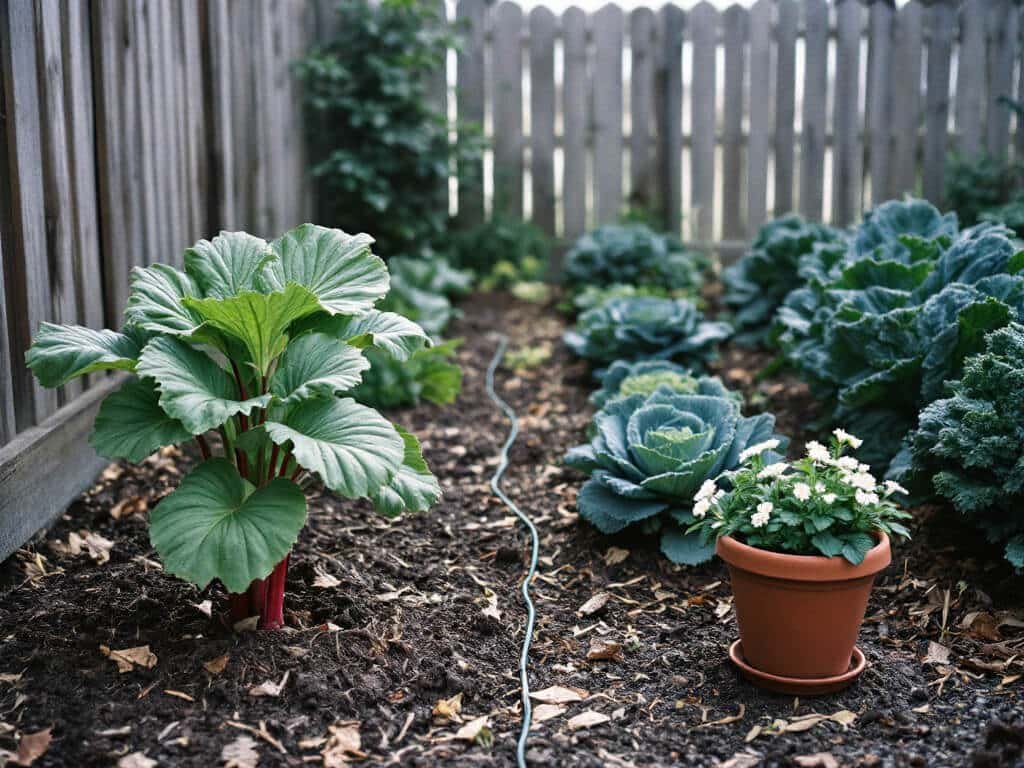
Put rhubarb at the edge of the vegetable garden or in its own bed, where it can stay put for years. Give each crown about 3 by 3 feet in full sun, and put seasonal crops and compatible perennials beyond that square. Containers are the best answer for any companion that wants different water or light.
Center: one rhubarb crown per 3 by 3 feet, in full sun and well-drained soil amended with organic matter.
Location: the edge of the vegetable garden or a dedicated bed, so neighbors don’t build up on all sides.
Outside the square: cabbage, broccoli, kale, cauliflower, and onions, on the outer edge of the planting area.
Separate permanent spaces: asparagus and horseradish, each with its own room. Contain the horseradish.
Strawberries: a separate border or container, not under the rhubarb canopy.
Garlic: well away from the crown, in full light.
Early crops: short-season vegetables near the edge that finish before the rhubarb shades them.
Weed watch: remove curly dock, thistle, and volunteer sunflowers from the bed and its surroundings.
Water the rhubarb deeply, about 1 inch a week, and keep the bed well drained. Poor drainage raises the risk of crown and root rots, and no companion plant will fix that.
FAQ
Can rhubarb and strawberries grow together?
Gardeners commonly recommend the pairing, but extension sources don’t establish a pest-control or yield benefit in either direction. Keep strawberries outside rhubarb’s 3-by-3-foot growing area and don’t let the rhubarb canopy shade them.
Can garlic be planted around rhubarb?
Garlic is often said to repel rhubarb pests, but that claim wasn’t verified in the available extension guidance. Tight planting also creates a light problem because rhubarb can shade the garlic, so leave generous separation.
What should never grow near rhubarb?
Remove curly dock, which is a normal host for rhubarb curculio. Thistle and volunteer sunflowers may also support the pest. Beyond that, keep tall or vigorous plants out of rhubarb’s growing space.