
Introduction
Choosing hydrangea companion plants comes down to one thing: finding plants that want the same light and water the shrub does. Hydrangeas like consistently moist, organically rich soil and, for most types, morning sun with afternoon shade. Put a drought-loving plant next to one, and one of the two will be unhappy by midsummer.
This guide covers eleven plants that fit that moist, partly shaded setup, plus the kinds of plants to keep away. It also covers how to lay out the bed when mature sizes vary as much as they do with hydrangeas. Hydrangeas grow across roughly zones 3 to 9 depending on species, and bigleaf hydrangea is the one most gardeners in zones 5 to 9 are growing. The pairings below work with that range.
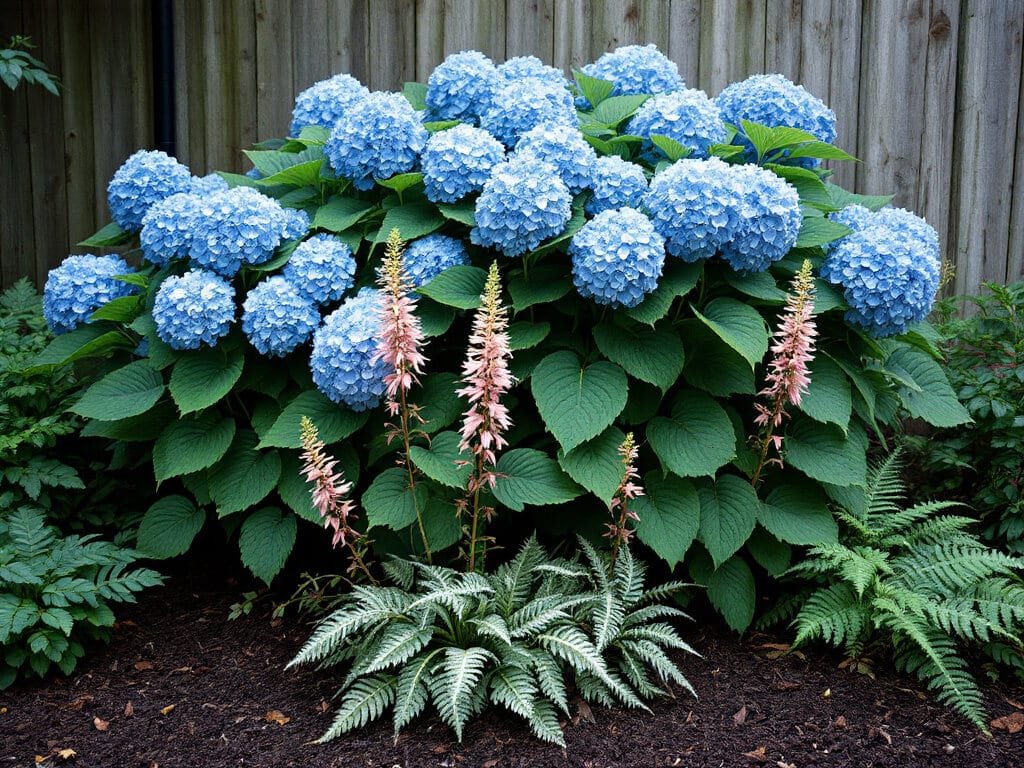
Why pairings matter for hydrangea
Hydrangeas are fussy about water. They do poorly in soggy soil and in excessively dry soil, so the plants around them need to be fine with the middle ground: moisture-retentive but well drained. A companion that needs a different watering schedule forces you to choose between the two.
Size is the other issue. Hydrangeas range from about 2 to 4 feet for some mountain hydrangeas, 3 to 5 feet for smooth hydrangeas, 6 to 15 feet for some large shrubs, and 30 to 40 feet for climbing hydrangea. A pairing that works around a compact mountain hydrangea can smother it or be smothered by a big one.
The problems worth planning around are cultural ones: drought stress, poor drainage, and reduced airflow. Good companions keep the soil covered and the shrub’s base open. Bad ones crowd it or pull the watering in the wrong direction.
Bloom timing matters too. Climbing hydrangea blooms May to July, mountain hydrangea June to August, and panicle and oakleaf hydrangeas July to September. Companions that flower earlier or later fill the gaps.
Best companion plants for hydrangea
Hosta
Hosta wants the same partial shade, rich soil, and steady moisture as hydrangea, so it needs no special treatment. It is the easiest default under and around a hydrangea. There is no verified hosta-to-hydrangea distance, so use the hydrangea’s mature spread to decide how far out to plant.
Astilbe
Astilbe likes moist, well-drained soil and partial shade, which is exactly the hydrangea bed. It adds plume-shaped flowers that look different from the hydrangea’s rounded blooms. Space it by the astilbe’s mature width, not a fixed hydrangea number.
Japanese painted fern
Japanese painted fern gives you contrasting foliage in a partial-shade, organically rich planting. It makes a good break between flowering plants. Place it according to the cultivar’s mature width, and keep air moving around the shrub.
Ferns
Other ferns add shade-tolerant foliage beneath or near hydrangeas where the soil stays moist. They fill the ground without competing for light. Leave room for each fern’s mature spread, since there is no universal spacing figure.
Hellebore
Hellebore blooms earlier than hydrangea, so it extends the season in a shade planting. That is its main job here: something to look at before the shrub leafs out and flowers. Use the hellebore’s mature width, and keep it from crowding the hydrangea’s base.
Coral bells
Coral bells are low growers with foliage and flowers, which makes them a front-of-the-bed plant. They give the layered look without hiding the hydrangea behind them. Take spacing from the cultivar label, because no hydrangea-specific distance is verified.
Rozanne geranium
Rozanne geranium covers ground beneath or in front of larger shrubs. It fills the space at the hydrangea’s feet with low growth. Leave enough room for both plants’ mature spreads rather than relying on a fixed number.
Begonia
Begonia gives you seasonal flowers in the same shaded spots hydrangeas like. It is a good pick for adding color around the shrub’s feet once the weather warms. Use the tag’s mature spacing, and keep plants or containers outside the hydrangea’s crown.
Anise hyssop
Anise hyssop has flowers that can support pollinators, and it suits sunnier sites better than most plants on this list. That makes it the pick for a sun-tolerant hydrangea, such as a panicle type, not a shade-dependent bigleaf. Follow both plants’ labels for spacing.
Eastern redbud
Eastern redbud gives spring flowers and can provide light afternoon shade for hydrangeas that don’t handle intense sun. Plant it only where the tree’s eventual canopy and root zone have room. No universal distance is verified, so check the mature size before you dig.
Japanese maple
Japanese maple can form part of a layered canopy over hydrangeas in a compatible light setting. Think of it as the top layer, with the shrub beneath and low plants under that. Account for the tree’s mature canopy and the hydrangea’s size, since the brief gives no fixed spacing.
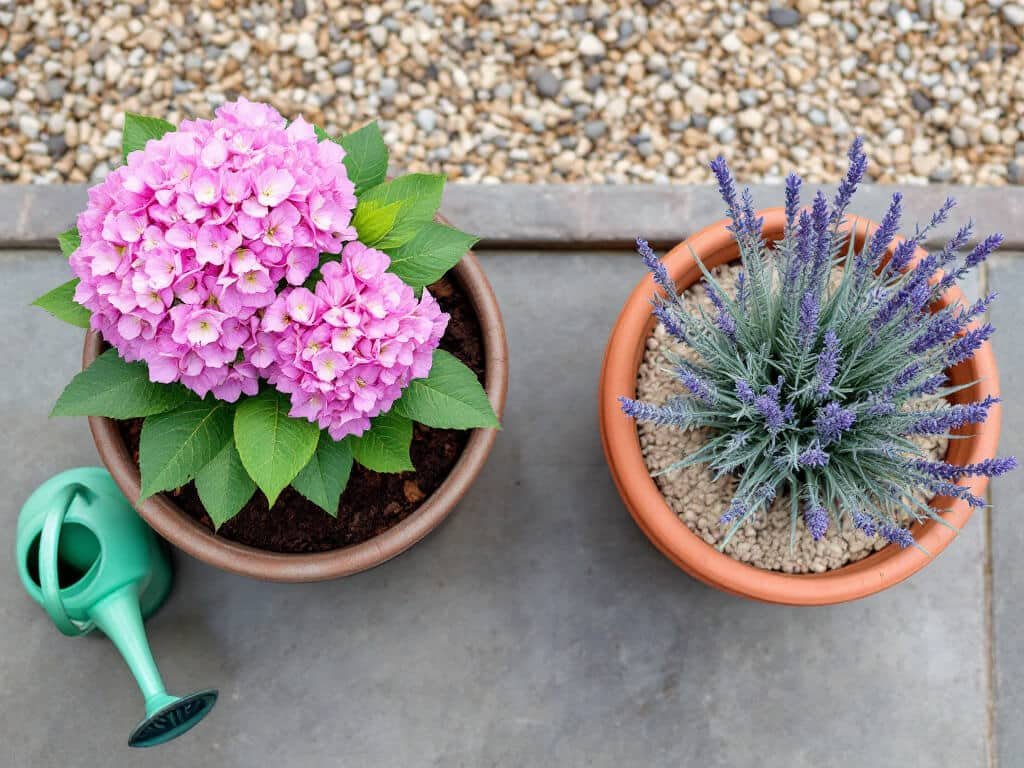
What not to plant with hydrangea
No single species has been verified as a universal bad companion for hydrangea. The problems come from mismatched needs, so judge a plant by what it demands, not its name.
Plants that need hot, dry soil
Anything that wants hot, dry soil conflicts with the hydrangea’s need for consistently moist ground. If you water for the hydrangea, a dry-soil plant will suffer, and if you water for the dry-soil plant, the hydrangea will wilt. Keep them in separate beds.
Plants that need full, intense afternoon sun
Plants that require full, intense afternoon sun create a light conflict beside shade-dependent hydrangeas. The cultivar matters here, because some hydrangeas tolerate more sun. Panicle hydrangeas are the usual example, and anise hyssop is a better partner for those.
Large, fast-growing plants set too close
Big, fast growers planted tight to a hydrangea compete for space and can cut airflow as they mature. Reduced airflow is one of the cultural problems to avoid. If you want a tree or large shrub nearby, give it room for its full size.
Plants with the same disease pressure
Crowding plants that share a site-specific disease problem can make management harder. The sources did not verify a particular species to avoid, so this is about spacing and watching what goes wrong in your own bed, not a blacklist.
Layout and spacing
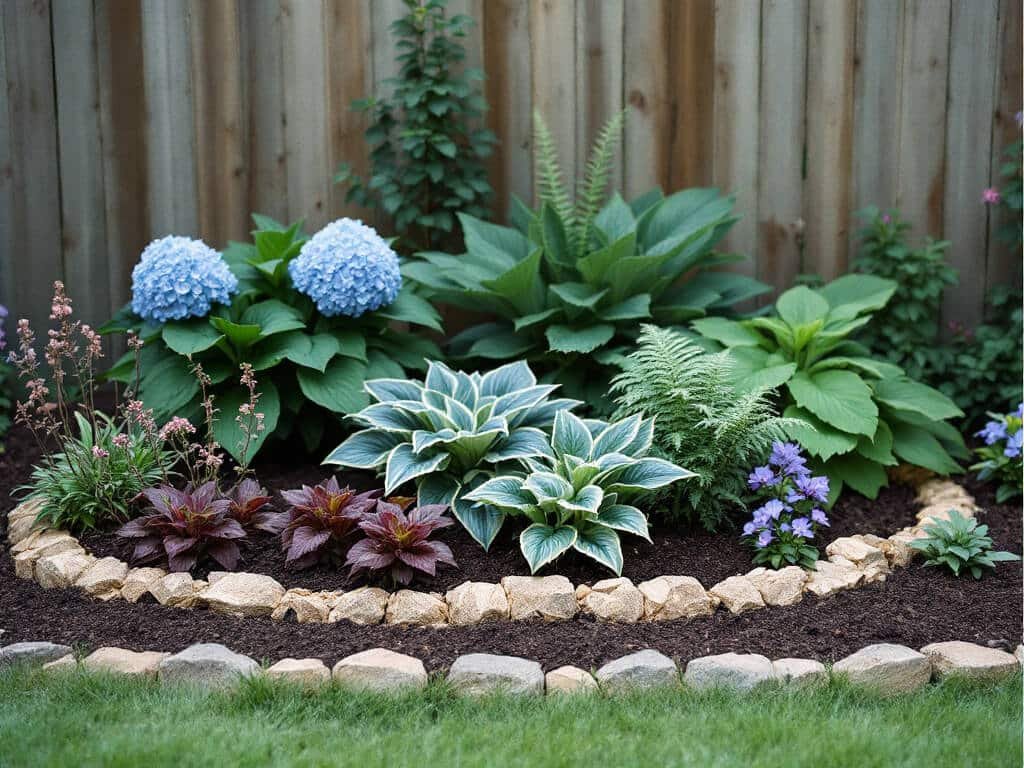
Plant the hydrangea toward the middle or back of the bed, based on its mature size, and put the lower plants in front of it. No single spacing rule fits every hydrangea or every companion, so use the hydrangea’s cultivar label and each companion’s mature width.
Back or middle: the hydrangea, placed by how big it will get.
Overhead, where there is room: Japanese maple or eastern redbud, planted with their mature canopy and root zone in mind.
Lower layers: hosta, ferns, Japanese painted fern, astilbe, and hellebore.
Front edge: coral bells and Rozanne geranium.
Seasonal color: begonias, kept outside the hydrangea’s crown.
Sunnier sites: anise hyssop with a sun-tolerant hydrangea.
Containers: combine only plants with the same light and moisture needs, and size the pot by the hydrangea’s mature size and cultivar label.
Keep the hydrangea’s base open, and leave gaps so air can move through the planting.
FAQ
Can hostas grow with hydrangeas?
Yes. Hostas and many hydrangeas share a preference for partial shade, organically rich soil, and consistent moisture.
Can hydrangeas grow in full sun?
Some types, especially panicle hydrangeas, tolerate or do well in full sun, but many hydrangeas benefit from afternoon shade. Plants in full sun generally need closer attention to watering.
How far apart should companion plants be from a hydrangea?
There is no single distance, because mature size varies so much among hydrangeas and companions. Use the hydrangea’s cultivar label and the companion’s mature width, and avoid crowding that restricts airflow.