
Tomato Companion Plants: What Helps and What Doesn’t
Choosing tomato companion plants comes down to two jobs: using bed space well and keeping pests down, without crowding the tomatoes or adding disease risk. Some pairings have a little research behind them. Plenty of popular advice has none.
Here is what holds up, what to skip, and how to lay it all out so the tomatoes still get what they need.
Why pairings matter for tomato
Tomatoes are fussy about conditions. They want at least 6 hours of direct sun, fertile, well-drained loamy soil with a pH of 6.2–6.8, and about 1–1½ inches of water per week, applied to the soil rather than the leaves. Anything you plant nearby either respects those needs or competes with them.
The pest and disease list is long: aphids, thrips, whiteflies, spider mites, fruit-feeding caterpillars, early blight, Septoria leaf spot, late blight, bacterial spot, bacterial canker, anthracnose, and blossom-end rot. A good companion might take a small bite out of the insect side of that list. A bad one adds humidity, shade, or a related disease host.
Two myths are worth clearing up. The first is that marigolds repel all tomato pests. Extension evidence is mixed, and a few studies found reduced thrips, which is not universal pest control. The second is that any plant labeled a “companion” will boost yield. Results depend on the species, spacing, season, and pest pressure, and research supports only certain combinations, with limited evidence for basil and marigolds.
My read: treat pest-deterrent claims as a possible bonus, and choose companions mainly for the space they use.
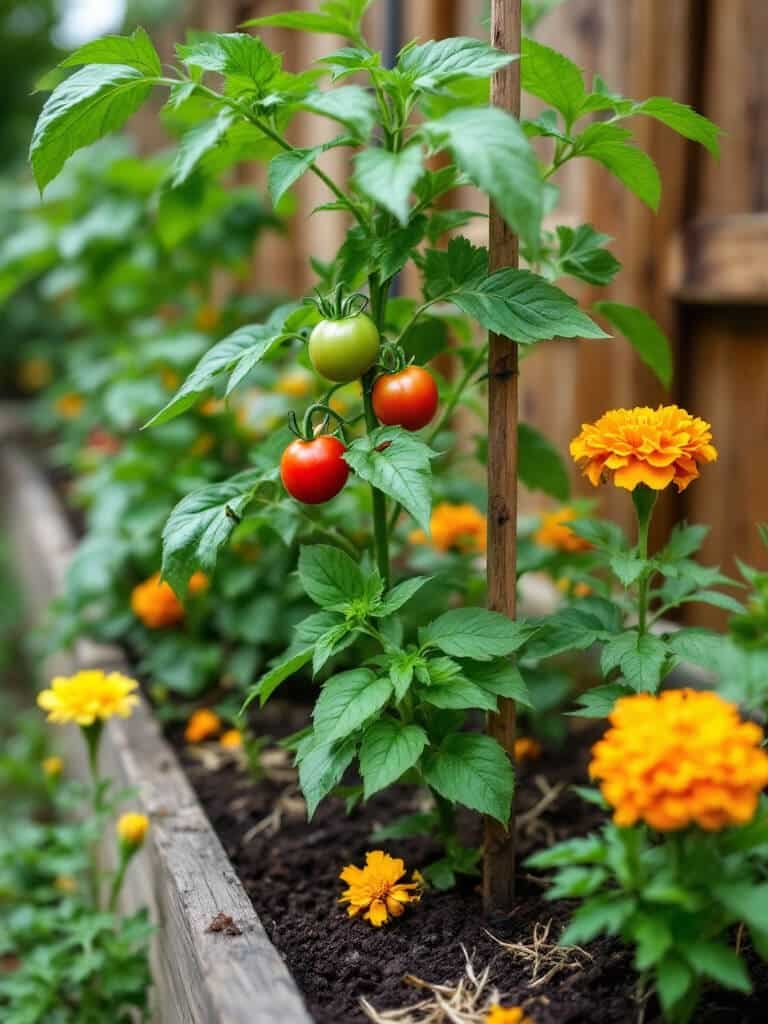
Best companion plants for tomato
Two of these, basil and marigold, have some research behind them for pest pressure. The rest earn their spot by filling space the tomato isn’t using yet, or never will. Those are the more dependable picks, because the benefit is simple: you harvest them before the tomato canopy closes in, or they sit low and out of the way.
Basil
Basil may reduce thrips and may promote tomato growth in some studies. The evidence is limited, so think of it as a reasonable bet rather than a guarantee. Plant it about 12–18 inches from the tomato, depending on how big the basil gets and how much airflow the spot needs.
Marigold
Marigolds may reduce thrips in some studies and may help deter aphids. They won’t clear your tomatoes of pests. Keep them about 12–18 inches from the tomato so neither plant crowds the other.
Lettuce
Lettuce uses early-season space beneath or between tomatoes before the tomato canopy expands. Sow or transplant it about 6–12 inches from the tomato, and keep the tomato’s required final spacing intact. Pull the lettuce as the tomato fills in.
Spinach
Spinach is a short-season crop you can harvest before tomatoes take over the bed. Place it about 6–12 inches from the tomato and leave room for airflow as the tomato grows. Like lettuce, it is a tenant with a lease that ends in early summer.
Radish
Radishes fill space quickly before tomato plants get large. Sow them outside the tomato’s root and support area, roughly 6–12 inches away. Keep them clear of the cage or stake so you aren’t disturbing the tomato’s roots when you pull them.
Carrot
Carrots use belowground space instead of the room your tomato support needs. Allow at least 6 inches between carrots and the tomato stem. They stay low, so they don’t compete with the tomato canopy.
Green onion
Green onions take up narrow vertical and belowground space and don’t form a dense canopy. Plant them roughly 6–8 inches from the tomato stem. They are one of the tightest-fitting options on this list.
Parsley
Parsley is a compact edible that can occupy lower bed space. Keep it about 8–12 inches from the tomato and don’t let it block air circulation. If it starts to crowd the base of the plant, trim it back.
Chives
Chives are a compact herb that can share the bed’s edge without competing for the tomato’s support structure. Allow about 8–12 inches from the tomato. The edge of the bed is the best spot for them.
Bush beans
Bush beans occupy a lower layer than tomatoes, but they must stay outside the tomato’s mature canopy. Allow at least 12–18 inches between plants and keep air moving through the bed. This is the companion that most easily ends up too close, so measure.
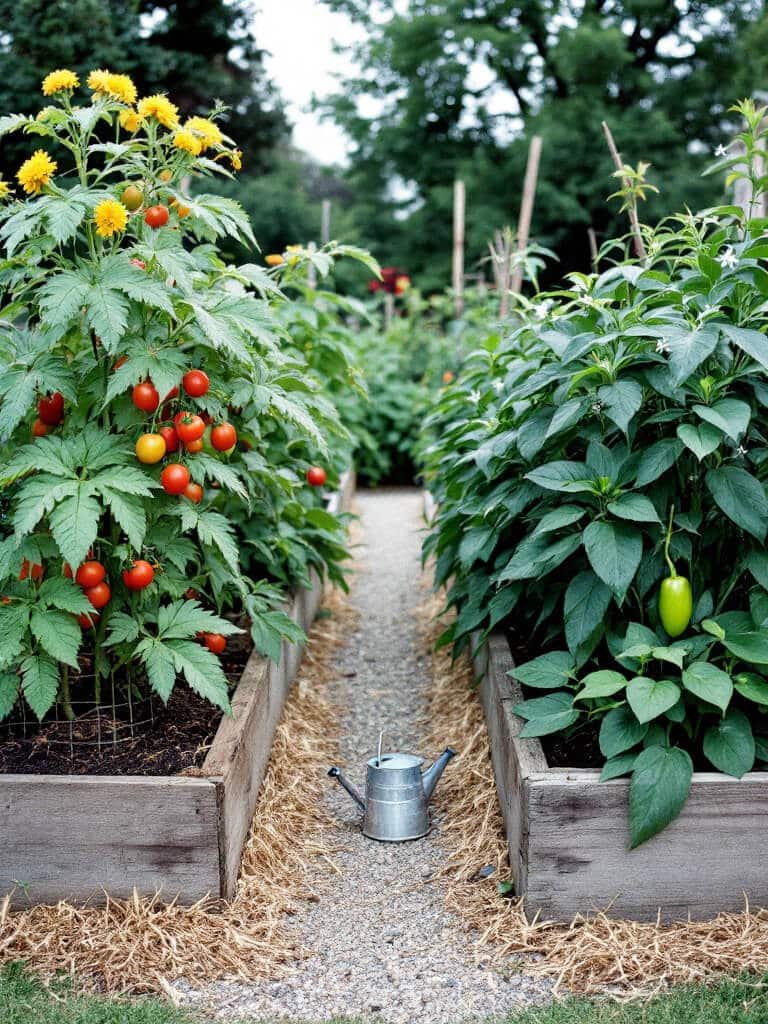
What not to plant with tomato
The “bad” list is mostly about disease and crowding. Nothing here is a hard ban in a single season, but each one is a reason to rethink the layout or the rotation.
Potatoes
Potatoes share the nightshade family with tomatoes and can carry or support overlapping soil-borne and foliar disease problems. Don’t plant them in the same area, and rotate nightshades for about three years. The “they’re related, so they must get along” idea gets it backward: the shared family is a reason to keep them apart, not evidence that they benefit one another.
Peppers
Peppers are related nightshades and share several disease concerns with tomatoes. They can grow side by side, but I wouldn’t count the pairing as beneficial. When you can, avoid putting them in the same rotation position.
Eggplant
Eggplant is another nightshade with several of the same disease risks. Rotate it away from the tomato bed instead of tucking it in next to the tomatoes. The same three-year logic applies.
Other tomatoes
Tomatoes planted too close together raise humidity and cut airflow, which raises disease risk. Space each plant for its growth habit and training system. A bed of tomatoes jammed together is a worse companion problem than any herb.
Corn
Tall corn can compete with tomatoes for light and takes up a lot of bed space. Treat it as a rotation crop rather than a guaranteed companion planting. If you want corn in the same garden, give it its own bed.
Layout and spacing
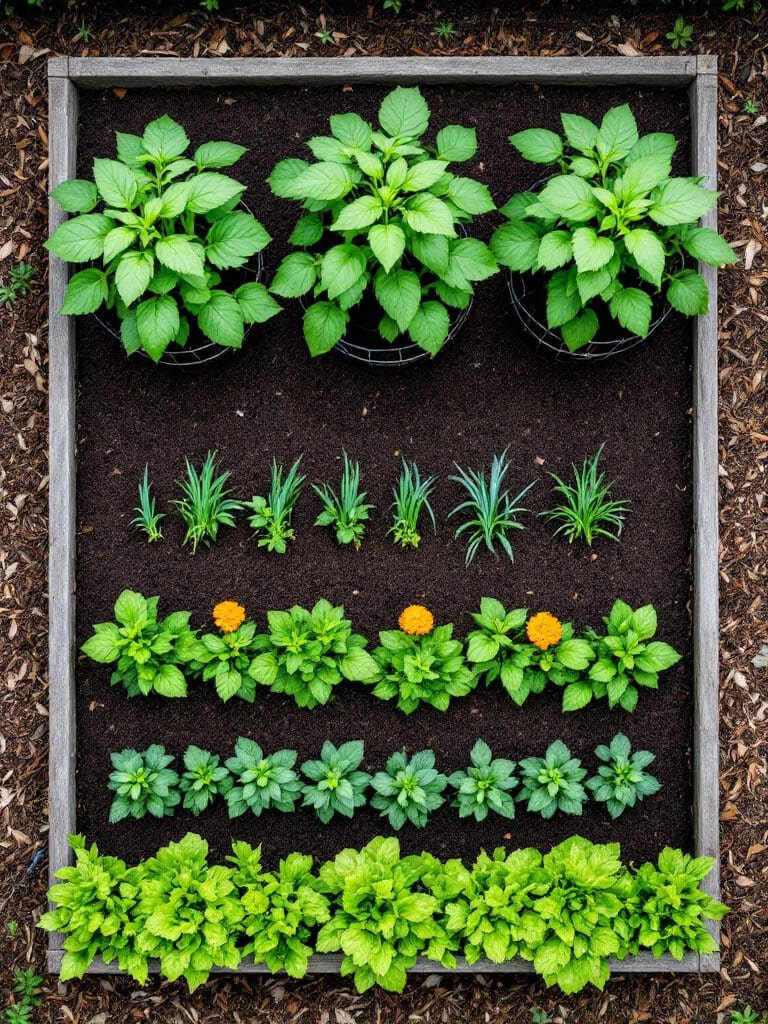
Never shrink the tomato’s spacing to fit companions. Put the tomatoes in the sunniest part of the bed, give each one its full cultivar-appropriate room, and set up a cage, stake, or trellis. Companions fill what’s left: the edges, plus early-season gaps that open up again once you harvest.
Determinate tomatoes: about 2 feet apart.
Indeterminate tomatoes in cages: about 3 feet apart.
Staked tomatoes: can go 18–24 inches apart.
Bed edge: basil, marigolds, and compact herbs like parsley and chives, kept where they don’t block airflow.
Early-season gaps: lettuce and spinach, harvested before the tomato canopy fills the space.
Root crops: carrots and green onions, at least 6 inches from the stem.
FAQ
What is the best companion plant for tomatoes?
Basil and marigolds have