
Limelight Hydrangea Companion Plants: What to Grow
Choosing limelight hydrangea companion plants comes down to one awkward fact: the shrub gets big, and most people plant its neighbors as if it won’t. A full-size Limelight reaches about 6–8 feet tall and can spread 6–12 feet wide, depending on the site and how you prune it. Pick plants that handle the same sun and soil, then give each one room based on its own mature width.
Below are ten plants that work beside it, four things to avoid, and a layout you can copy.
Why pairings matter for Limelight hydrangea
Limelight (Hydrangea paniculata ‘Limelight’) is a deciduous, woody shrub rated for USDA zones 3–9. It takes full sun to light shade, and in hot climates morning sun with afternoon shade is easier on it. It wants moist, fertile, well-drained soil that is kept evenly moist, especially while it’s getting established and during dry spells.
That moisture profile is the main filter for companions. A plant that needs soggy ground, or one that wants to be left bone dry, will be unhappy sharing a bed with Limelight. Most of the plants below are sun-lovers that sit comfortably in the middle: not swampy, not desert.
Size is the second filter. Limelight is a large shrub, and anything planted too close will be shaded, crowded, or fighting for water and nutrients within a few seasons. Plant for the mature shrub, not the one-gallon pot you bring home.
Third is bloom timing. Limelight flowers from summer into autumn. The heads open lime green, fade to creamy white, and can pick up pink tones as they age. Companions that bloom earlier, flower at the same time in a contrasting color, or add texture after the show starts to fade keep the bed interesting across the whole season.
Finally, airflow. Limelight can get leaf spot, rust, powdery mildew, Botrytis, and bacterial wilt, and pests include aphids, hydrangea scale, vine weevil, and deer. Crowded, stagnant plantings make foliar problems more likely, so open spacing is part of the plan, not an afterthought.
Best companion plants for Limelight hydrangea
One caution before the list. These plants are well supported as compatible design choices, but there are no verified, plant-specific spacing measurements for every pairing. Where I give a number, it’s a starting point. For the rest, check the nursery tag for the companion’s mature width and work from there.
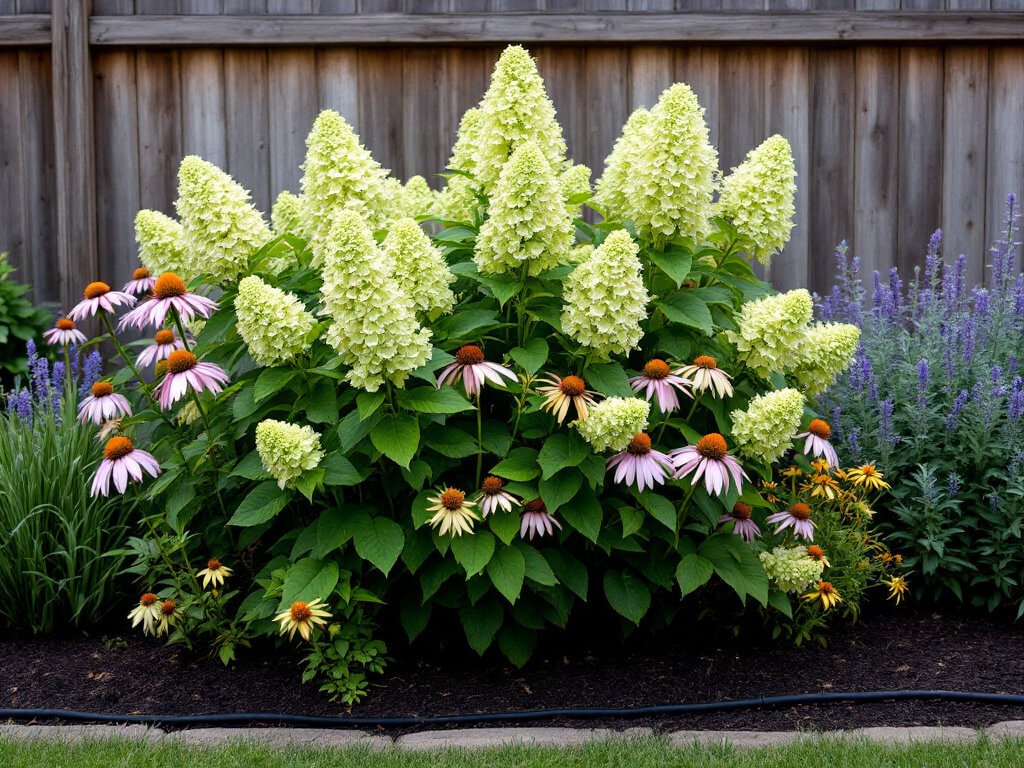
Purple coneflower (Echinacea purpurea)
Coneflower shares Limelight’s sunny site and its late-season flowering, and its purple is a strong contrast against lime and cream. Plant it about 2–3 feet from the edge of the hydrangea’s mature canopy, not in the trunk zone.
Black-eyed Susan (Rudbeckia spp.)
Black-eyed Susan puts yellow flowers in the bed during Limelight’s summer display and suits the same full-sun style of planting. Allow roughly 2–3 feet from the canopy edge, and adjust for the cultivar, since some run larger than others.
Joe-Pye weed (Eutrochium spp.)
This one brings late-season flowers and extra vertical height to a naturalistic planting. Put it where its mature height won’t crowd the hydrangea, generally several feet from the canopy. It’s a better fit behind or beside Limelight than in front of it.
Catmint (Nepeta spp.)
Catmint gives you a low, purple-flowering layer and tolerates sunny conditions once established. Leave about 18–24 inches between the catmint and the hydrangea’s canopy edge, adjusted for the cultivar’s spread. It’s a good front-of-bed plant because it stays well below the shrub’s height.
Russian sage (Salvia yangii)
Russian sage adds a lavender-purple haze and upright texture in a sunny bed, which plays well against Limelight’s rounded form. Give it about 2–3 feet from the hydrangea’s canopy edge.
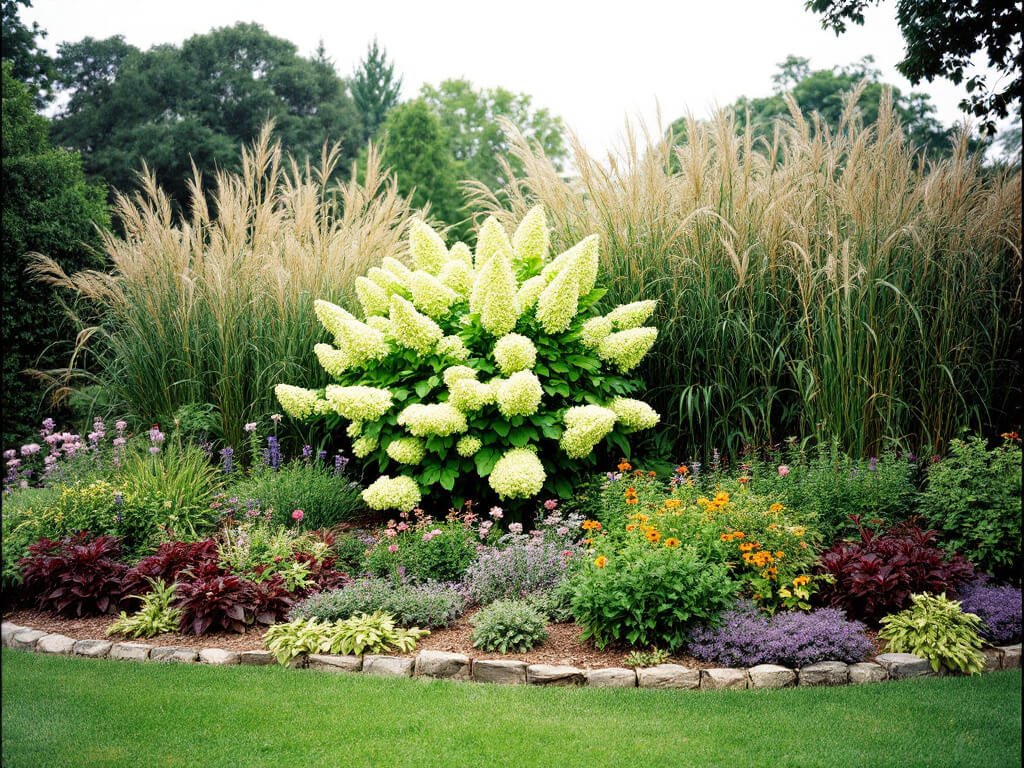
Karl Foerster feather reed grass (Calamagrostis × acutiflora ‘Karl Foerster’)
The grass adds vertical texture against the hydrangea’s mounded shape. Plant it several feet from the shrub so mature clumps don’t merge with the hydrangea’s base. It works best behind or beside Limelight.
Switchgrass (Panicum virgatum)
Switchgrass gives you movement and upright form, and it shares Limelight’s preference for sun. Space it by the selected cultivar’s mature width, and keep it outside the hydrangea’s main root and stem zone. Check the tag first, because switchgrass cultivars vary quite a bit in size.
Coral bells (Heuchera spp.)
Coral bells offer a low foliage layer, with burgundy and other leaf colors that contrast with Limelight’s green and cream. Use them only where the site gives the cultivar enough light, and keep them outside the hydrangea’s immediate trunk zone. I’d use them as an edging plant at the front of the bed.
Peonies (Paeonia spp.)
Peonies bloom earlier, so they carry the bed before Limelight’s main summer display begins. Separate them from the hydrangea by their mature spread. Keep their crowns from getting buried under hydrangea mulch.
Dwarf spirea (Spiraea spp.)
Dwarf spirea is a lower shrub layer with earlier color, which makes it useful in a foundation planting. Leave room for both shrubs’ mature widths rather than planting it right against the hydrangea.
What not to plant with Limelight hydrangea
This list is shorter than you might expect, and it’s based on water, size, and airflow rather than folklore.
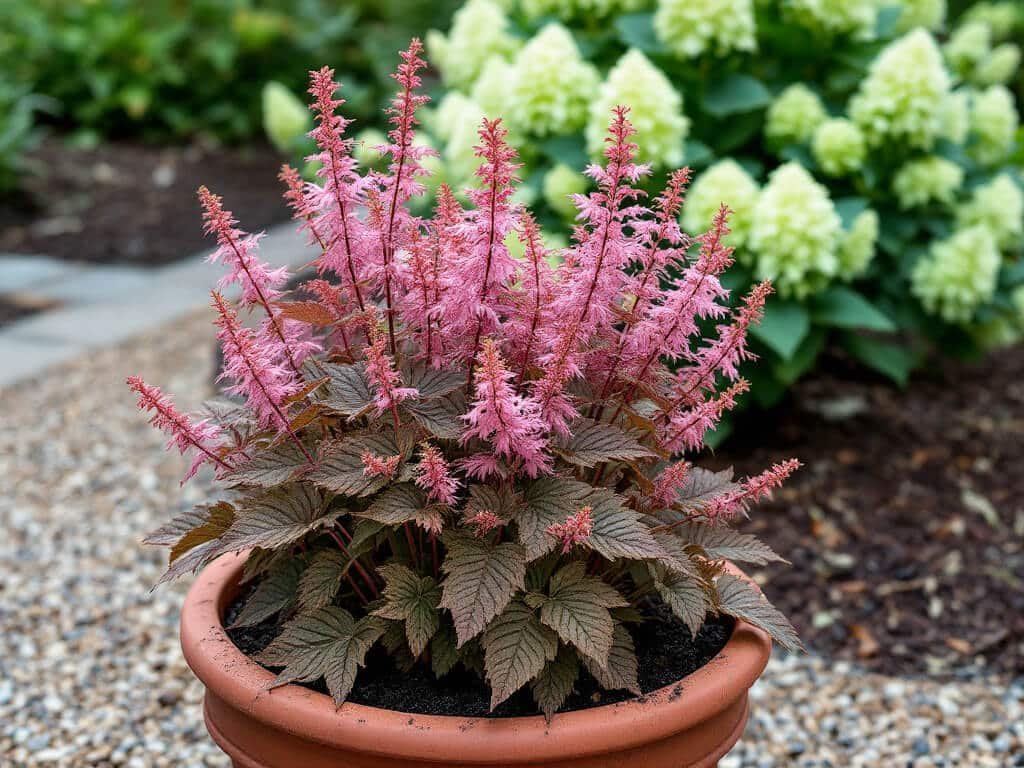
Astilbe
Astilbe prefers consistently moist conditions. In a Limelight bed that is kept merely evenly moist and well drained, it may struggle. I’d skip it here unless you know the spot stays wetter than average.
Plants that require waterlogged soil
Limelight wants moist but well-drained ground. Bog-type plants conflict with that, and constantly saturated soil can increase root and disease problems for the shrub.
Large, aggressive shrubs inside Limelight’s mature spread
Don’t plant big, vigorous shrubs within the hydrangea’s eventual 6–12 foot spread. They compete for water, nutrients, light, and physical space, and a shrub that reaches 6–8 feet tall leaves little room to share. If you want another large shrub nearby, space it from the hydrangea’s mature width, not its current size.
Dense, poorly ventilated plantings
Packing the bed tight increases crowding and may worsen foliar disease, and Limelight can be susceptible to leaf spot, mildew, and other diseases. Airflow between plants is cheap insurance. Resist filling every gap in the first year.
One more note. No reliable source names a specific plant that chemically harms Limelight, so you can ignore advice about “toxic neighbors.” Shared water needs, mature size, and airflow are the criteria that hold up.
Layout and spacing
Treat Limelight as the tall anchor of the bed and build the rest of the planting around its eventual size. Measure from the canopy edge of the mature shrub, then add each companion’s own mature width.
– Place Limelight at the back or center of the bed. A full-size plant commonly needs about 6–8 feet of room for its own development.
– Put grasses or tall perennials, such as Karl Foerster feather reed grass or Joe-Pye weed, behind or beside it.
– Fill the middle with coneflower, black-eyed Susan, or Russian sage, about 2–3 feet off the canopy edge.
– Edge the front with catmint (18–24 inches from the canopy edge), coral bells, or other low plants.
– Keep the trunk zone open and mulch-free of competing crowns, and leave gaps for air to move through.
For containers, use only compact Limelight cultivars such as ‘Little Lime’ or ‘Limelight Prime’. The standard full-size plant is not a practical choice for a typical small container.
FAQ
Can Limelight hydrangea grow in full sun?
Yes. Limelight grows in full sun to light shade, though morning sun with afternoon shade can be better in hot climates, particularly where soil dries quickly.
How far should companion plants be from Limelight hydrangea?
There is no single spacing that fits every companion. Start with Limelight’s eventual size, about 6–8 feet tall with a broad spread, and place each companion by its own mature width, keeping the trunk zone and airflow clear.
What should not be planted beside Limelight hydrangea?
Avoid plants with incompatible water needs, especially those that require waterlogged soil, and large or aggressive plants that will take over the hydrangea’s mature space. Astilbe may also be a poor match in a drier, well-drained Limelight bed.