
Hollyhock Companion Plants: What to Grow Nearby
Choosing hollyhock companion plants comes down to two things: matching the plant’s need for full sun and well-drained soil, and not crowding a plant that reaches 6 to 8 feet tall. Get those right and most sunny-border perennials will work. Get them wrong and you end up with a humid, shaded tangle where rust has an easy time.
This article covers which plants make good neighbors, which ones to keep away, and how to lay it all out. It also corrects one common claim about companion planting that doesn’t hold up.
Hollyhocks (Alcea rosea) are usually short-lived perennials or biennials. Many plants flower in their second year, then self-sow, so the planting changes from season to season. They like full sun, fertile and well-drained soil, and moderate water while they establish and bloom.
Common hollyhock is generally hardy in USDA zones 3 to 8, though cultivar hardiness varies. If you garden in zone 9, check the plant tag before you buy.
A good companion shares those conditions: sun, decent drainage, and no appetite for constant water. It also stays out of the way of the tall stems and doesn’t smother the base.
Why pairings matter for hollyhock
Hollyhocks are tall, narrow, and often bare at the bottom. Companions fill in the lower layers, extend the bloom calendar, and give pollinators something to visit before and after hollyhocks flower in summer.
Spacing matters for a more practical reason. Rust is the main disease concern, and aphids and hollyhock weevils can also show up. Good spacing and airflow help limit disease pressure, so the wrong neighbor, one that crowds or holds humidity around the leaves, can do more harm than any pest.
One myth is worth clearing up. No extension-backed evidence shows that marigolds, lavender, or other commonly listed companions reliably repel hollyhock pests or prevent rust. Companions earn their spot through compatible growing conditions, layered form, and pollinator value. Anyone telling you a neighbor plant will protect your hollyhocks is overselling it.
Best companion plants for hollyhock
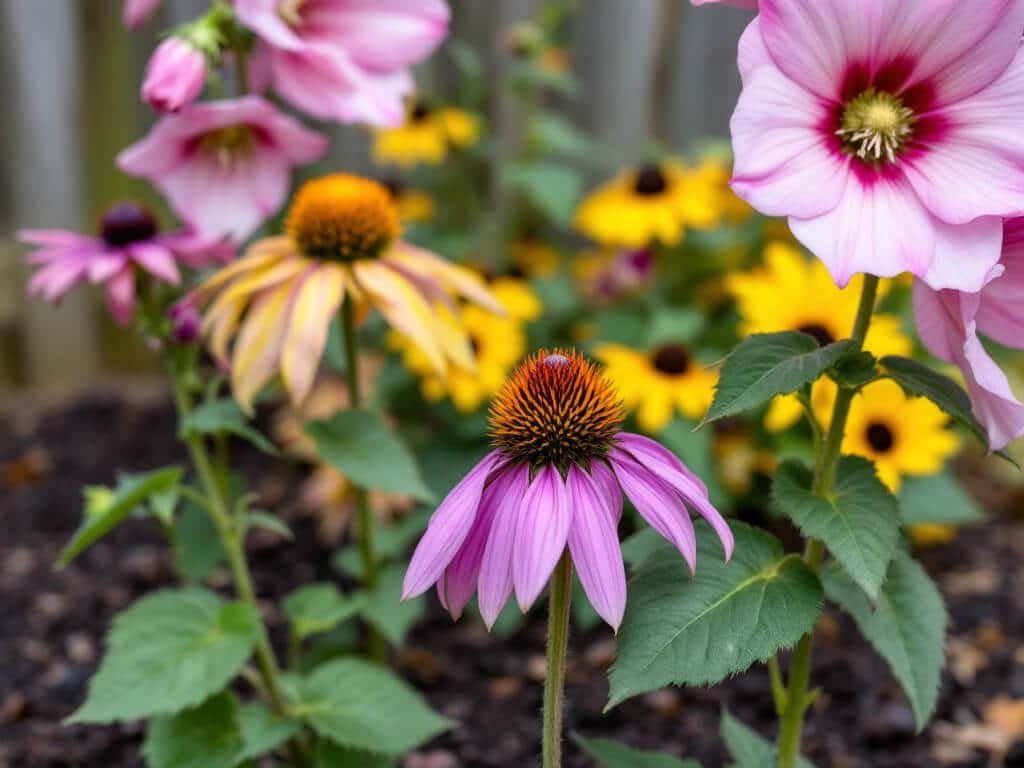
Purple coneflower (Echinacea purpurea)
Coneflower fills the middle layer in front of hollyhocks and attracts bees and butterflies. One gardening source reports planting it about 18 inches in front of hollyhocks. Treat that as a design suggestion for your site, not a universal rule, and adjust for the mature spread of the variety you buy.
Black-eyed Susan (Rudbeckia spp.)
This is a full-sun, summer-flowering plant that helps fill the lower border. It’s another middle-layer option, and about 18 inches in front of hollyhocks is reported by the same source. Check the mature spread locally before you commit to a spot.
Lavender
Lavender gives you low-growing contrast and pollinator forage, and it wants the same sunny, relatively well-drained conditions hollyhocks do. No verified spacing exists for lavender next to hollyhocks. Use the mature spread of your hollyhock cultivar and keep the gap open enough for air to move.
Yarrow (Achillea millefolium)
Yarrow is drought-tolerant and adds low-to-medium-height texture and pollinator forage in front of tall stems. No hollyhock-specific spacing was found, so go by yarrow’s own mature width and leave room around the hollyhock base.
Salvia
Salvia adds lower-growing flowering contrast and pollinator forage. It sits comfortably in front of tall stems. There’s no verified hollyhock-specific spacing, so use the mature width on the plant tag.
Catmint (Nepeta spp.)
Catmint has low, spreading foliage and flowers that can soften bare lower hollyhock stems. That’s its main job here, and it does it well. No hollyhock-specific spacing was found, so plan around its mature spread and keep it from piling up against the hollyhock crowns.
Sweet alyssum (Lobularia maritima)
Sweet alyssum is a low groundcover whose flowers attract hoverflies. Hoverfly larvae prey on aphids, which gives this one a modest practical benefit. Use it along the front edge. No hollyhock-specific spacing was found, so follow the seed packet or plant tag.
Asters
Asters bloom later in the season and extend pollinator resources after hollyhock bloom is over. They keep the back of the border from going quiet in fall. No hollyhock-specific spacing exists, so use each variety’s mature width.
Spring bulbs such as daffodils
Daffodils and similar bulbs provide earlier-season color before hollyhocks reach full height. Follow the bulb’s package spacing rather than looking for a hollyhock figure. Plant them where later growth from hollyhocks and perennials will cover the fading foliage.
Peonies
Peonies bloom earlier and have dense foliage that can occupy the lower border around tall hollyhocks. No hollyhock-specific spacing was found. Give the peony its full mature width so its foliage doesn’t press against hollyhock stems.
What not to plant with hollyhock
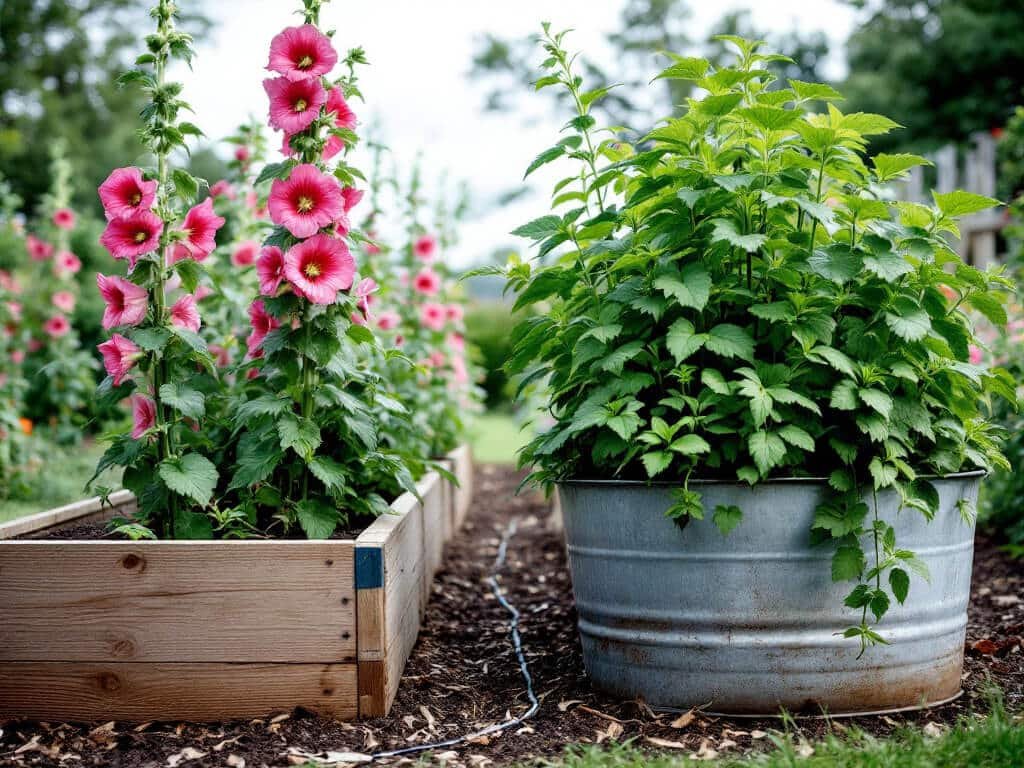
Mint
Mint spreads aggressively and can overtake a planting, competing with young hollyhocks. If you want mint nearby, grow it in a contained pot and keep it out of the bed.
Running bamboo
Running bamboo spreads hard and is difficult to remove. It creates direct competition and a maintenance problem you will be dealing with for years. Keep it well away from the border.
Dense shrubs immediately beside hollyhocks
Shrubs planted right up against hollyhocks can cut air circulation and create conditions favorable to fungal disease. Rust is already the main threat, so don’t help it along. A shrub a few feet back is fine. One pressed against the stems is not.
Large sunflowers
Large sunflowers may compete strongly for light, water, and nutrients in a crowded bed. This is a practical competition concern rather than a documented hollyhock-specific incompatibility. In a roomy bed with space between them, you may be fine, but I’d skip them in a tight border.
Giant ornamental grasses
Giant grasses can crowd hollyhocks and compete for resources when planted too closely. If you love them, give them real distance and a different part of the bed.
Other dense, tall plantings
Anything dense and tall can shade lower companions and restrict airflow, which adds up to a crowded, humid planting. Hollyhocks are already the tall thing in the border. They don’t need competition for that role.
Layout and spacing
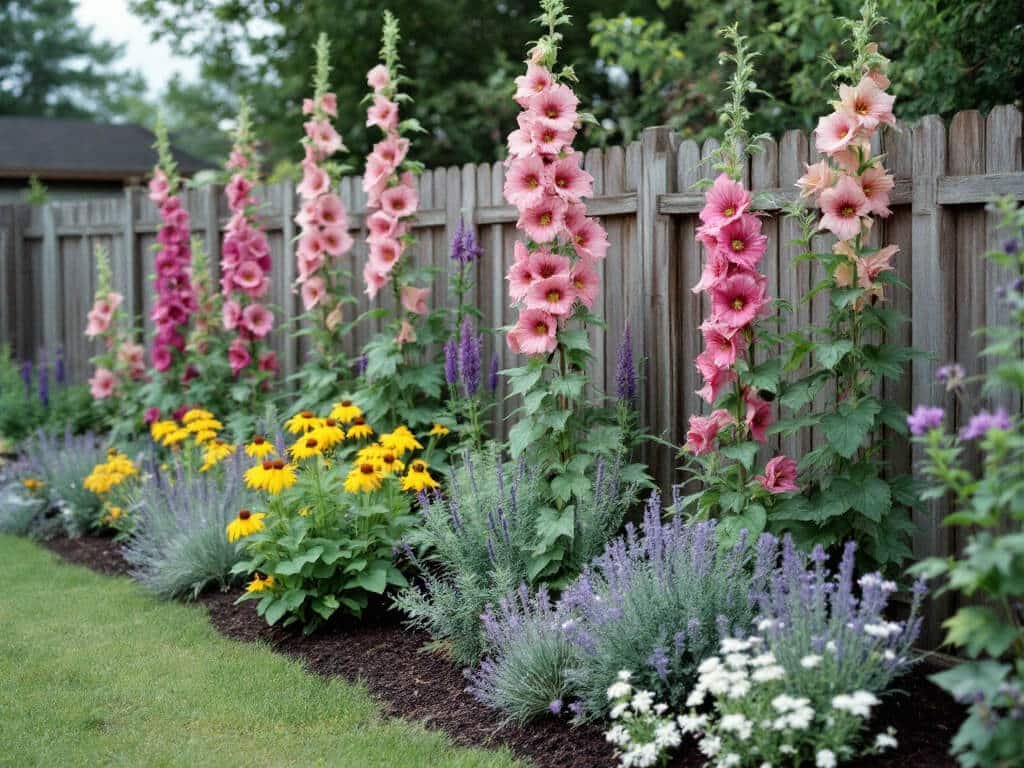
Put hollyhocks at the back of the bed or along a fence, then step down in height toward the front. Spacing for most of these pairings isn’t backed by a verified hollyhock-specific number, so use each plant’s mature width to set the final gaps. Do not count on companion plants to control rust; open airflow and avoiding dense, shrub-like neighbors do more.
Back row: hollyhocks against a fence or at the rear of the bed.
Middle layer: purple coneflower and black-eyed Susan, about 18 inches in front of the hollyhocks if your site allows. Adjust for mature spread.
Front edge: lavender, catmint, and sweet alyssum, sited by their own mature widths.
Early season: daffodils and other spring bulbs, spaced per the package, for color before hollyhocks fill out.
Late season: asters, to carry pollinators past hollyhock bloom.
FAQ
Which plants grow well with hollyhocks?
Choose plants that tolerate full sun and well-drained soil, such as coneflowers, black-eyed Susans, yarrow, salvia, lavender, catmint, sweet alyssum, and asters. These pairings are supported mainly by compatible growing conditions, layered form, bloom timing, or pollinator value, not proven pest control.
Can hollyhocks grow beside roses?
Yes, roses and hollyhocks are a traditional visual combination, and both can occupy a sunny cottage-garden border. Keep the planting open enough for air movement and avoid placing hollyhocks directly against dense growth.
Do companion plants prevent hollyhock rust?
No reliable evidence supports a particular companion plant as a rust preventative. Reducing leaf wetness, maintaining airflow, and avoiding crowded or humid conditions are more defensible recommendations.