
Blue Spruce Companion Plants: What to Grow Nearby
Choosing blue spruce companion plants comes down to two things: sun and drainage. The tree wants full sun and moderately moist, well-drained soil, and it grows 30 to 60 feet tall and 10 to 20 feet wide (some references list up to 75 feet). Anything you plant nearby has to live with those conditions, not change them.
Below are ten sun-loving perennials, grasses, and groundcovers that fit, a short list of plants to keep away, and a layout that leaves the spruce room to breathe. Blue spruce is generally rated for zones 2 to 7 and can struggle in hot, humid conditions, so gardeners in zones 8 and 9 should expect a harder time with the tree itself, whatever grows beside it.
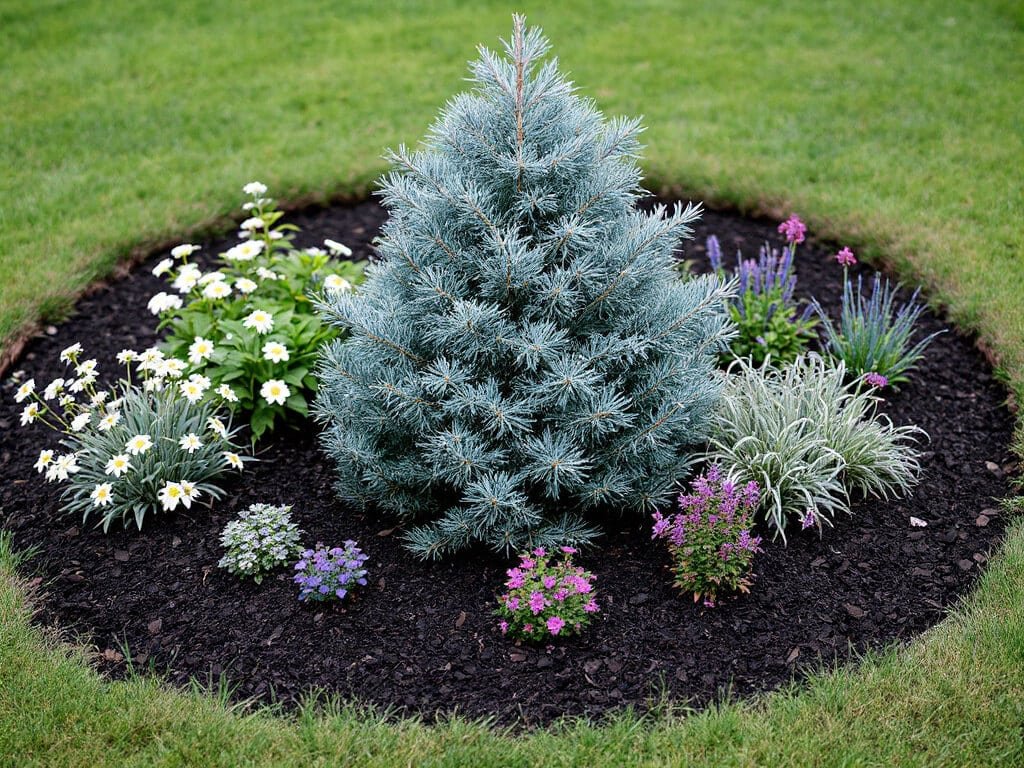
Why pairings matter for blue spruce
Blue spruce is not hard to please, but it has a few weak spots. Dense shade can cause needle loss and bare branches. Heavy clay and poorly drained soil increase stress and nutrient problems. Crowded plantings cut airflow, and the tree is prone to needle casts such as Rhizosphaera, as well as Cytospora canker, spruce adelgids, spider mites, budworm, bagworms, and bark beetles.
So the neighbors you pick matter mostly for what they do to light, water, and air movement around the tree. A thirsty plant that keeps the soil wet, or a thick shrub packed against the trunk, creates the conditions the spruce handles worst.
One myth to clear up: companion planting will not repel blue spruce pests or prevent needle cast. Extension sources describe most companion-planting claims as folklore or experimentation, with evidence that is suggestive at best. Treat the plants below as compatible design companions, not pest-control partners.
Best companion plants for blue spruce
Every plant here shares the spruce’s taste for sun and well-drained soil. The spacing figures are conservative layout recommendations based on mature plant size and the need to keep the trunk uncrowded. They come from plant size, not from blue-spruce-specific trials.
Creeping juniper
A low evergreen groundcover with the same preference for full sun and well-drained sites. Plant it at least 10 feet from the trunk of a full-size blue spruce, or follow the mature spread listed for the cultivar you buy.
Sedum
A low, drought-tolerant filler for the sunny outer edge of the root zone. Place it 3 to 5 feet from the trunk, depending on how far your cultivar spreads.
Yarrow (Achillea millefolium)
A full-sun perennial that brings flowers for visiting insects. Plant it about 3 feet from the trunk.
Catmint (Nepeta spp.)
A full-sun flowering perennial that tolerates dry spells fairly well. It suits the front of the planting, about 3 feet from the trunk.
Russian sage (Salvia yangii)
An upright, sun-loving perennial that adds height to a bed otherwise made of low plants. Give it about 4 feet from the trunk.
Lavender (Lavandula spp.)
A good choice for sunny, dry spots with sharp drainage. Plant it about 3 feet from the trunk, and don’t put it anywhere the soil stays wet.
Switchgrass (Panicum virgatum)
A clumping ornamental grass that adds contrasting texture in a lower layer of the planting. Set it 3 to 4 feet from the trunk, closer to 4 if your cultivar is a wide one.
Little bluestem (Schizachyrium scoparium)
A full-sun native grass with upright form and seasonal texture. Plant it about 3 feet from the trunk.
Coneflower (Echinacea purpurea)
A flowering perennial that adds pollinator interest around the sunny perimeter. Place it 2 to 3 feet from the trunk.
Black-eyed Susan (Rudbeckia hirta)
A summer-blooming perennial that puts color in front of the evergreen backdrop. Plant it 2 to 3 feet from the trunk.
What not to plant with blue spruce
No reputable source has identified a plant that poisons or chemically suppresses blue spruce. The plants to avoid are the ones whose needs conflict with the spruce’s, or whose density makes disease pressure worse.
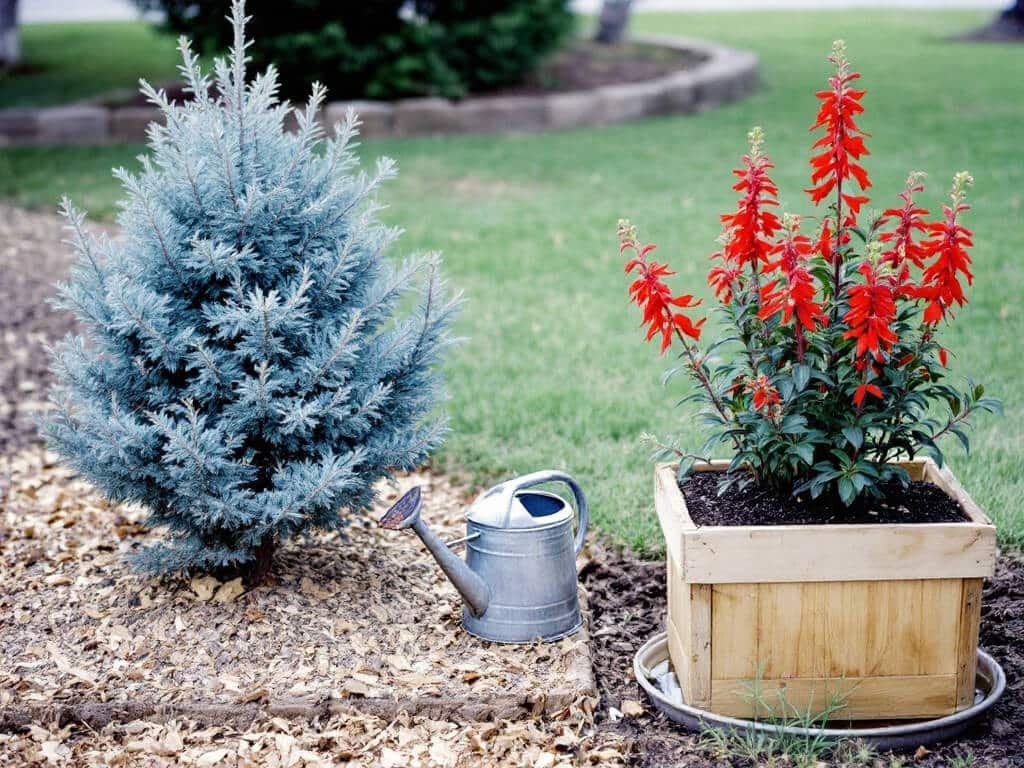
Bog plants such as cardinal flower (Lobelia cardinalis)
They need consistently moist conditions, and the spruce needs well-drained soil. One of you is going to be unhappy, and it is usually the tree.
Water-loving willows
Willows prefer wetter ground and can compete hard for water and root space. They don’t belong in the same bed as a tree that dislikes standing water.
Large, dense shrubs planted close to the trunk
They cut airflow and crowd the tree. Purdue Extension notes that proper spacing helps reduce needle-cast incidence, so a hedge-like wall against the trunk works in the wrong direction.
Plants that require dense shade
A mature blue spruce does cast shade, but the tree itself performs best in full sun and can lose needles when shaded. Don’t pull more light away from it by planting tall, shade-casting neighbors, and don’t choose shade lovers that only work if the spruce is crowded in.
Plants that need frequent irrigation at the trunk
Persistent wetness and poor drainage near the trunk increase stress and disease risk. If a plant needs regular watering, it needs to live somewhere you can water it without soaking the spruce’s root flare.
Layout and spacing
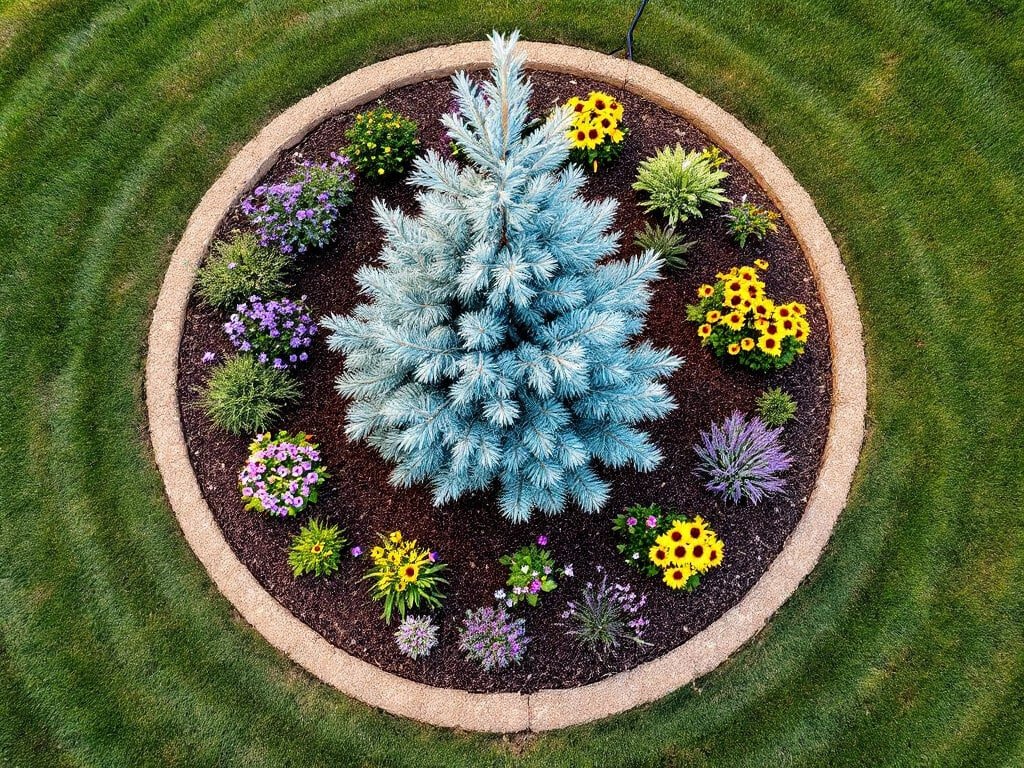
Leave a wide, open ring around the trunk instead of filling the bed up to the bark. Put the low, sun-loving plants toward the outer edge, keep the tree’s mature spread and airflow in mind, and aim for evenly moist but well-drained soil with no standing water.
– Keep the bark and the base of the trunk clear of plants.
– Coneflower and black-eyed Susan sit closest, at 2 to 3 feet.
– Yarrow, catmint, lavender, and little bluestem go at about 3 feet.
– Switchgrass goes at 3 to 4 feet, and sedum at 3 to 5 feet, depending on cultivar width.
– Russian sage goes at about 4 feet.
– Creeping juniper goes at 10 feet or more from a full-size tree.
– Water new plantings where they stand, not at the trunk, and fix any low spot where water pools.
FAQ
Which plants are proven to repel blue-spruce pests?
None. No reliable extension evidence establishes a specific companion plant as a proven pest repellent for blue spruce, and many companion-planting claims have never been conclusively tested.
How far should companion plants be from blue spruce?
Keep plants away from the immediate base of the trunk and leave room for the tree’s mature spread and airflow. For specific plants in this article, the range runs from 2 to 3 feet (coneflower) up to 10 feet (creeping juniper).
Can blue spruce grow with plants that need frequent watering?
Only if the site stays well drained and the watering doesn’t leave the spruce in saturated soil. Blue spruce prefers moderately moist, well-drained soil and can suffer in heavy clay, excess moisture, or standing water.