
Catnip Companion Plants: What to Grow Nearby
Choosing catnip companion plants comes down to one practical problem: catnip is a spreader, and the evidence that it protects its neighbors is thinner than most garden lists suggest. Catnip is reported to deter flea beetles and cabbage moths, but that is not the same as proven crop protection.
The common claim that catnip reliably repels a broad range of garden pests is not established by the extension sources reviewed. Lab studies show that nepetalactone, the compound in catnip, repels insects, but that doesn’t mean a whole plant growing in your bed does the same job. Treat any pest benefit as a possible bonus, and pick pairings based on how the plants will actually get along.
This article covers which plants make sensible neighbors, which situations to avoid, and how to lay out a bed so catnip stays in its lane.
Why pairings matter for catnip
Catnip is a herbaceous perennial in the mint family, hardy in zones 3 to 9. It grows about 2 to 3 feet tall and spreads broadly, both by seed and by underground growth. Recommended plant spacing is 10 to 18 inches, and a plant left alone will fill that space and then some.
That growth habit is the main reason pairings matter. A neighbor planted too close gets crowded for light, water, and nutrients. A neighbor with very different water needs ends up either overwatered or underwatered, because catnip wants good drainage and doesn’t tolerate persistently wet soil.
Catnip prefers full sun but tolerates light shade. It needs moderate water while establishing, then even moisture during dry spells, as long as the soil drains. Average soil or soil amended with compost suits it. The best companions share those conditions or can be kept far enough away that their care doesn’t clash.
Exact catnip pairings have limited research behind them. The strongest support is for its reported use near crops bothered by flea beetles or cabbage moths, and for its value as a flowering plant for pollinators. The spacing figures below are conservative placement recommendations based on catnip’s spread, not distances tested in experiments.
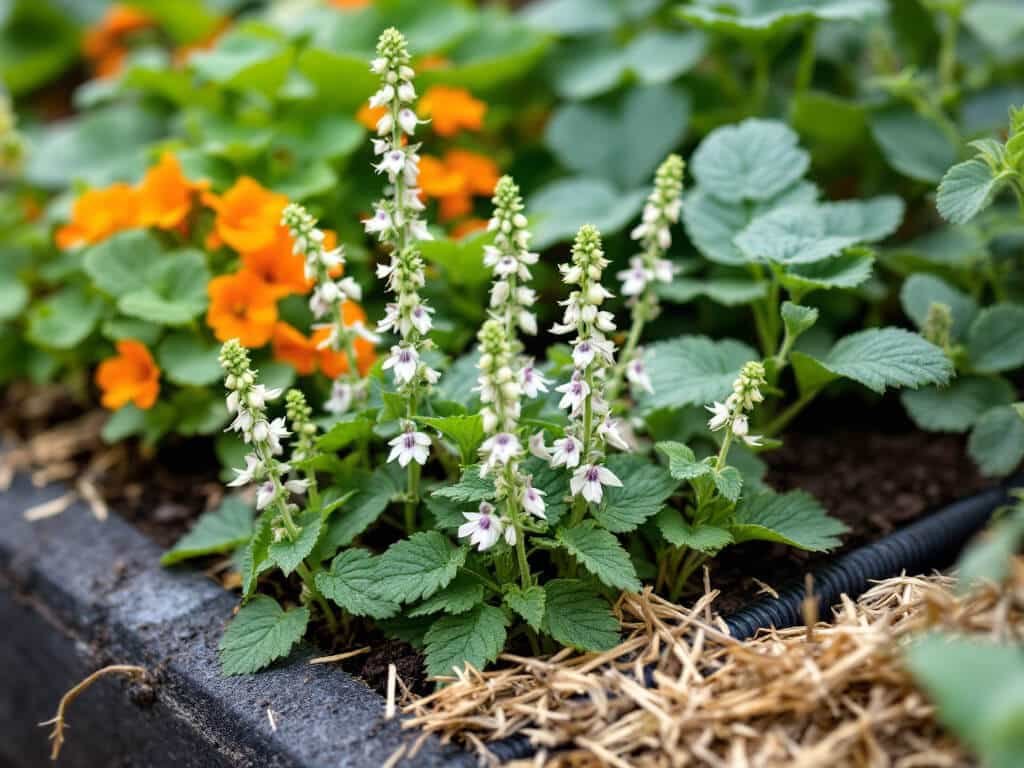
Best companion plants for catnip
Cabbage-family crops
Catnip is reported to deter cabbage moths and flea beetles, which is the most commonly cited reason to plant it near broccoli, cabbage, kale, and similar crops. Keep the nearest catnip plant at least 18 inches from the crop, and farther if you let the catnip spread.
Bush beans
Catnip is listed as a companion for bush beans and is reported to repel flea beetles. Beans are compact, so crowding is the risk here. Keep catnip at least 18 inches from the bean plants.
Pole beans
The same flea beetle reasoning applies to pole beans. Plant catnip at least 18 inches away, outside the bean row, so it doesn’t send runners under the trellis.
Eggplant
Eggplant is a flea beetle target, and catnip is reported as a possible deterrent. Place catnip about 18 inches or more from the eggplant, preferably at the bed edge where it can be trimmed without disturbing the crop.
Peppers
Catnip is reported as useful near crops affected by aphids, and peppers fall into that group. Leave at least 18 inches between plants, and prune the catnip before it shades the peppers.
Turnips
Catnip is listed among suggested companions for turnips. Turnips are a row crop with little space to spare, so leave at least 18 inches between catnip and the row.
Sorrel
Catnip is listed as a companion for sorrel. Both are perennial-minded plants that stay put, which makes spacing more important. Use at least 18 inches between them because catnip can spread.
Nasturtium
Catnip is listed as a companion for nasturtium. Both plants sprawl, so give them at least 18 inches and watch that neither one overruns the paths.
Sage
Sage and catnip both show up in companion recommendations for vegetable beds, especially around cabbage-family crops. They also share a preference for well-drained soil, which makes the care routine easy to match. Keep at least 18 inches between them.
Rosemary
Rosemary is reported as a catnip companion, and both plants like sun and sharp drainage. That shared preference is the real benefit: you won’t be tempted to overwater one to suit the other. Leave at least 18 inches between plants, and keep rosemary out of the frequent irrigation meant for thirstier crops.
What not to plant with catnip
No reputable source in the research establishes a definitive list of plants that are biologically incompatible with catnip. The problems below are management issues, not proven chemical effects, so you can often solve them with spacing or a container.
Small, delicate herbs and seedlings
Cats drawn to catnip may trample whatever is growing next to it. Seedlings and small herbs lose out in that situation. Separate them with a barrier, or grow the catnip in a protected container.
Tightly spaced annual vegetables
Catnip can spread and crowd out neighbors, and annuals planted close together have no room to push back. Leave at least 18 inches and remove flower heads before they release seed.
Plants that need consistently wet soil
Catnip prefers well-drained conditions, and frequent irrigation can increase the risk of root problems. A moisture-loving plant next to it forces a compromise that neither one enjoys. Put catnip in a separate, drier zone of the garden.
Plants with limited root-zone space
Vigorous catnip growth competes for space, water, and nutrients. Shallow-rooted crops are the most exposed. Use a container or root barrier if catnip has to sit near them.
Other mint-family plants in a rotation
Catnip and many culinary herbs belong to the Lamiaceae family, and repeatedly planting the same family in one spot can encourage shared pest buildup. Don’t treat catnip as a substitute for crop rotation. Keep track of where mint-family plants have been, catnip included.
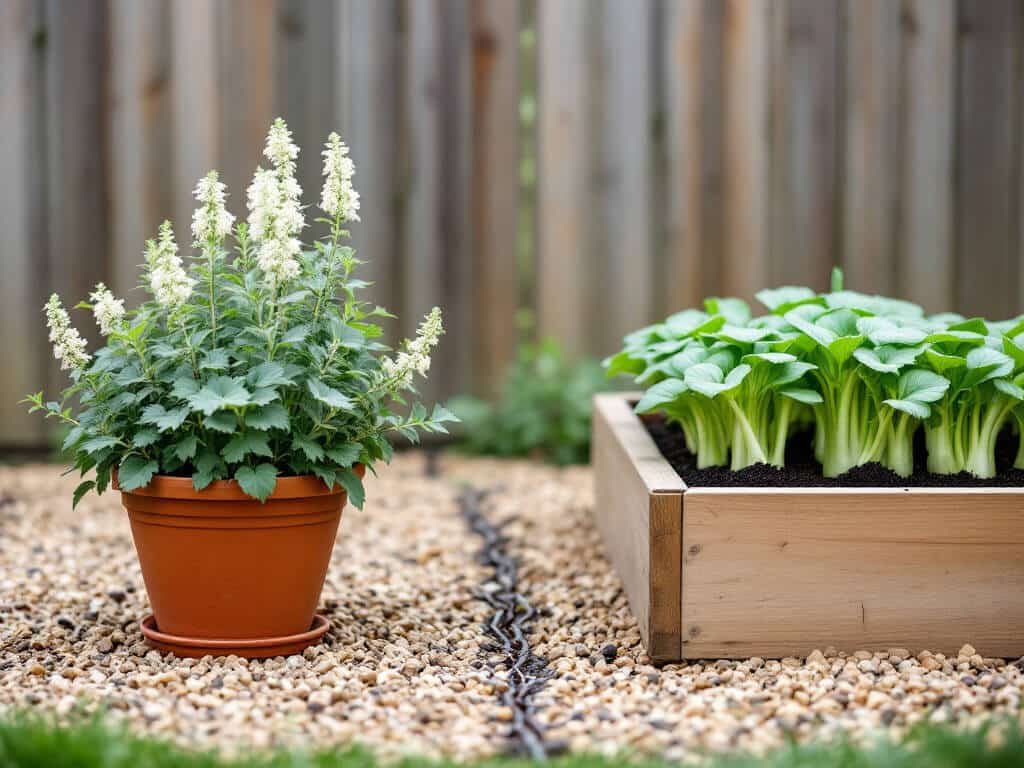
Layout and spacing
The simplest approach is to give catnip its own spot: the edge of a sunny bed, a dedicated corner, or a container set beside the crops you hope it will help. From there, the work is mostly maintenance. Keep catnip at least 18 inches from neighboring plants.
– Plant catnip at the edge of a sunny bed, not in the middle of a crop row.
– Place the nearest catnip plant at least 18 inches from beans, cabbage-family crops, eggplant, peppers, turnips, sorrel, nasturtium, sage, or rosemary.
– Use a container or root barrier near shallow-rooted crops.
– Remove spent flowers to limit self-seeding.
– Prune catnip before it shades peppers or other sun-hungry neighbors.
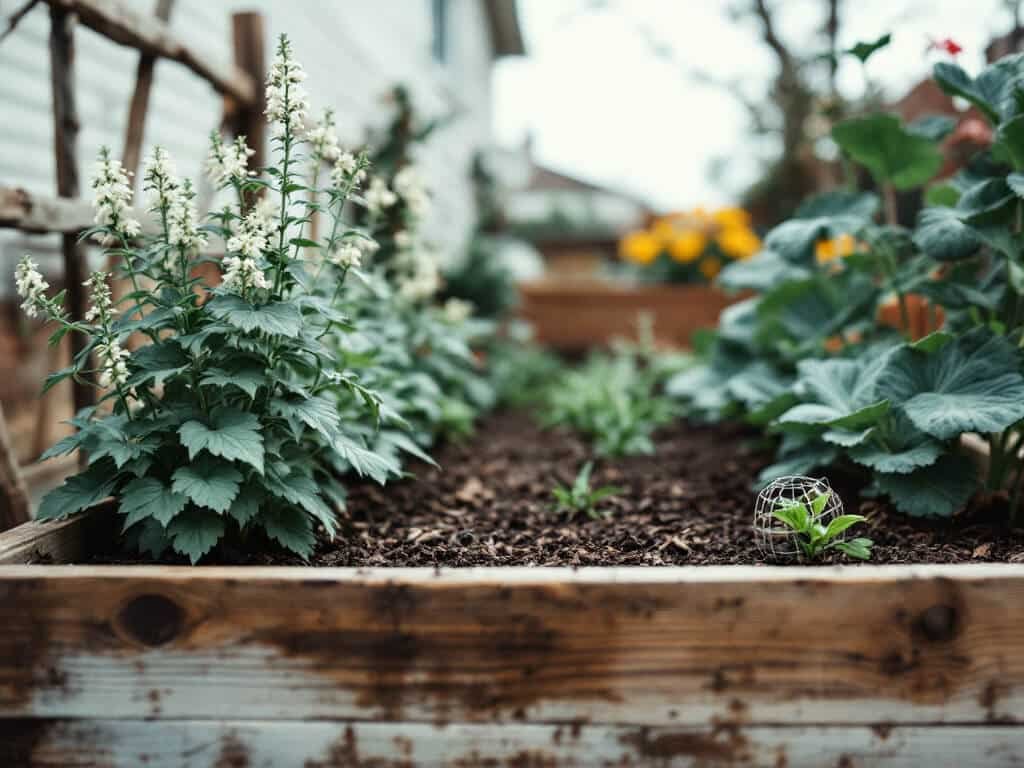
– Cover young plants with wire mesh to protect them from cats.
– Keep it away from plants that need frequent watering, and place it in the drier part of the garden.
Catnip flowers and leafy stems are generally harvested while the plant is in bloom, from early summer into early fall depending on your climate. If you plan to cut it for drying, keeping it at the bed edge makes harvesting easy and keeps you from stepping on its neighbors.
FAQ
Does catnip repel garden pests?
Catnip is reported to deter flea beetles and cabbage moths, but how strong or reliable that effect is in an outdoor garden is uncertain. Lab repellency findings shouldn’t be treated as guaranteed crop protection.
Can catnip be planted beside vegetables?
Yes. Sources list catnip near beans, cabbage-family crops, eggplant, peppers, turnips, sorrel, and nasturtium. Because it spreads, keep it at least 18 inches from neighboring plants.
Should catnip be grown in a container?
A container is a practical choice because catnip spreads by seed and underground growth. It also helps protect young plants from cats and keeps catnip separate from closely spaced crops.